Advertisements
Advertisements
प्रश्न
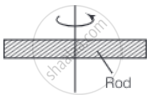
A uniform metallic rod rotates about its perpendicular bisector with constant angular speed. If it is heated uniformly to raise its temperature slightly ______.
विकल्प
its speed of rotation increases.
its speed of rotation decreases.
its speed of rotation remains same.
its speed increases because its moment of inertia increases.
Advertisements
उत्तर
A uniform metallic rod rotates about its perpendicular bisector with constant angular speed. If it is heated uniformly to raise its temperature slightly its speed of rotation decreases.
Explanation:
As the rod is heated, it expands. No external torque is acting on the system so angular momentum should be conserved.
L = Angular momentum = Iω = constant
⇒ I1ω1 = I2ω2
Due to the expansion of the rod I2 > I1
⇒ `ω_2/ω_1 = I_1/I_2 < 1`
⇒ `ω_2 < ω_1`
So, angular velocity (speed of rotation) decreases.
APPEARS IN
संबंधित प्रश्न
A hole is drilled in a copper sheet. The diameter of the hole is 4.24 cm at 27.0 °C. What is the change in the diameter of the hole when the sheet is heated to 227 °C? Coefficient of linear expansion of copper = 1.70 × 10⁻⁵ K–1.
If mercury and glass had equal coefficients of volume expansion, could we make a mercury thermometer in a glass tube?
If an automobile engine is overheated, it is cooled by pouring water on it. It is advised that the water should be poured slowly with the engine running. Explain the reason.
A system X is neither in thermal equilibrium with Y nor with Z. The systems Y and Z
Show that the moment of inertia of a solid body of any shape changes with temperature as I = I0 (1 + 2αθ), where I0 is the moment of inertia at 0°C and α is the coefficient of linear expansion of the solid.
Answer the following question.
State applications of thermal expansion.
Solve the following problem.
In olden days, while laying the rails for trains, small gaps used to be left between the rail sections to allow for thermal expansion. Suppose the rails are laid at room temperature 27 °C. If maximum temperature in the region is 45 °C and the length of each rail section is 10 m, what should be the gap left given that α = 1.2 × 10⁻⁵K–1 for the material of the rail section?
A student records the initial length l, change in temperature ∆T and change in length ∆l of a rod as follows:
| S.No. | l(m) | ∆T (C) | ∆l (m) |
| 1. | 2 | 10 | `4 xx 10^-4` |
| 2. | 1 | 10 | `4 xx 10^-4` |
| 3. | 2 | 20 | `2 xx 10^-4` |
| 4. | 3 | 10 | `6 xx 10^-4` |
If the first observation is correct, what can you say about observations 2, 3 and 4.
Find out the increase in moment of inertia I of a uniform rod (coefficient of linear expansion α) about its perpendicular bisector when its temperature is slightly increased by ∆T.
Calculate the stress developed inside a tooth cavity filled with copper when hot tea at temperature of 57°C is drunk. You can take body (tooth) temperature to be 37°C and α = 1.7 × 10⁻⁵/°C, bulk modulus for copper = 140 × 109 N/m2.
The height of mercury column measured with brass scale at temperature T0 is H0. What height H' will the mercury column have at T = 0°C. Coefficient of volume expansion of mercury is γ. Coefficient of linear expansion of brass is α ______.
A metal ball immersed in water weighs w1 at 0°C and w2 at 50°C. The coefficient of cubical expansion of metal is less than that of water. Then ______.
A disc is rotating freely about its axis. The percentage change in angular velocity of a disc if temperature decreases by 20°C is ______.
(coefficient of linear expansion of material of disc is 5 × 10⁻⁴/°C)
If the temperature of the sun were to increase from T to 2T and its radius from R to 2R, then the ratio of the radiant energy received on earth to what it was previously will be ______.
A glass flask is filled up to a mark with 50 cc of mercury at 18°C. If the flask and contents are heated to 38°C, how much mercury will be above the mark? (α for glass is 9 × 10⁻⁶/°C and coefficient of real expansion of mercury is 180 × 10-6/°C)
Which of the following correctly lists the three types of thermal expansion?
When a solid is heated, its atoms vibrate faster and move farther apart. This happens because ______.
Among solids, liquids, and gases, the thermal expansion on heating is ______.
A metallic bar of Young’s modulus, 0.5 × 10¹¹ N m−2 and coefficient of linear thermal expansion 10−5°C−1, length 1 m and area of cross-section 10−3 m2 is heated from 0°C to 100°C without expansion of bending. The compressive force developed in it is ______.
