Advertisements
Advertisements
Question
The coefficient of volume expansion of glycerin is 49 × 10–5 K–1. What is the fractional change in its density for a 30 °C rise in temperature?
Advertisements
Solution 1
Coefficient of volume expansion of glycerin, αV = 49 × 10–5 K–1
Rise in temperature, ΔT = 30°C
Fractional change in its volume =`(triangle V)/V`
This change is related with the change in temperature as:
`(triangle V)/V = alpha_V triangle T`
`V_(T_2) - V_(T_1) = V_(T_1) alpha_V triangle T`
`m/rho_(T_2) - m/rho_(T_1) = m/rho_(T_1) alpha_1 triangleT`
Where,
m = Mass of glycerine
`rho_(T_1)` = Initial density at `T_1`
`rho_(T_2)` = Final density at `T_2`
`(rho_(T_1) - rho_(T_2))/rho_(T_2) = alpha_1 triangle T`
Where
`(rho_(T_1) - rho_(T_2_))/(rho_T_2)` = = Fractional change in density
∴Fractional change in the density of glycerin = 49 ×10–5 × 30 = 1.47 × 10⁻²
Solution 2
Here `gamma= 49 xx 10^(-5) ""^@C^(-1)`, `triangle T = 30 ""^@C`
As` V = V + triangle V = V(1+gamma triangle T)`
`V' = V(1+49xx10^(-5)xx30) = 1.0147 V`
Since `rho = m/V, rho^n = m/(V') = m/1.0147V = 0.9855 rho`
Fractional change in density = `(rho - rho')/rho`
`= (rho - 0.9855 rho)/rho = 0.0145`
APPEARS IN
RELATED QUESTIONS
A hole is drilled in a copper sheet. The diameter of the hole is 4.24 cm at 27.0 °C. What is the change in the diameter of the hole when the sheet is heated to 227 °C? Coefficient of linear expansion of copper = 1.70 × 10⁻⁵ K–1.
If mercury and glass had equal coefficients of volume expansion, could we make a mercury thermometer in a glass tube?
For a constant-volume gas thermometer, one should fill the gas at
Show that the moment of inertia of a solid body of any shape changes with temperature as I = I0 (1 + 2αθ), where I0 is the moment of inertia at 0°C and α is the coefficient of linear expansion of the solid.
Answer the following question.
Derive the relation between three coefficients of thermal expansion.
A glass flask has a volume 1 × 10⁻⁴ m3. It is filled with a liquid at 30°C. If the temperature of the system is raised to 100°C, how much of the liquid will overflow? (Coefficient of volume expansion of glass is 1.2 × 10⁻⁵ (°C)−1 while that of the liquid is 75 × 10−5 (°C)−1).
A metre scale made of a metal reads accurately at 25 °C. Suppose in an experiment an accuracy of 0.12 mm in 1 m is required, the range of temperature in which the experiment can be performed with this metre scale is ______.(coefficient of linear expansion of the metal is `20 xx 10^-6 / (°"C")`
A metal sphere 10.01 cm in diameter is placed on a brass ring of internal diameter 10 cm and at the same temperature of 12° C. The temperature up to which they should be heated together so that the metal sphere just passes through the ring is `[alpha_"metal"= 12 xx 10^-6//°"C" and alpha_"brass" =18 xx 10^-6//°"C"]` ____________.
A metal rod of length Land cross-sectional area A is heated through T °C. What is the force required to prevent the expansion of the rod lengthwise?
(Y = Young's modulus of material of the rod, α = coefficient of linear expansion of the rod.)
A bimetallic strip is made of aluminium and steel (αAl > αsteel) . On heating, the strip will ______.
Find out the increase in moment of inertia I of a uniform rod (coefficient of linear expansion α) about its perpendicular bisector when its temperature is slightly increased by ∆T.
Calculate the stress developed inside a tooth cavity filled with copper when hot tea at temperature of 57°C is drunk. You can take body (tooth) temperature to be 37°C and α = 1.7 × 10⁻⁵/°C, bulk modulus for copper = 140 × 109 N/m2.
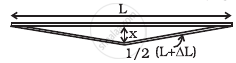
A rail track made of steel having length 10 m is clamped on a raillway line at its two ends (figure). On a summer day due to rise in temperature by 20° C, it is deformed as shown in figure. Find x (displacement of the centre) if αsteel = 1.2 × 10⁻⁵/°C.
If the length of a cylinder on heating increases by 2%, the area of its base will increase by ______.
Which of the following correctly lists the three types of thermal expansion?
Among solids, liquids, and gases, the thermal expansion on heating is ______.
A metallic bar of Young’s modulus, 0.5 × 10¹¹ N m−2 and coefficient of linear thermal expansion 10−5°C−1, length 1 m and area of cross-section 10−3 m2 is heated from 0°C to 100°C without expansion of bending. The compressive force developed in it is ______.
The volume of a block of metal at 30°C changes by 0.12% when its temperature is increased to 70°C. The coefficient of linear expansion of the metal is ______.
