Advertisements
Advertisements
Question
Show that the moment of inertia of a solid body of any shape changes with temperature as I = I0 (1 + 2αθ), where I0 is the moment of inertia at 0°C and α is the coefficient of linear expansion of the solid.
Advertisements
Solution
Given:
Coefficient of linear expansion of solid = α
Moment of inertia at 0 °C = I0
If temperature changes to θ from 0 °C, then change in temperature, (ΔT) =θ
Let I be the new moment of inertia attained due to rise in temperature.
Let R0 be the radius of gyration at 0 °C.
We know that on heating, radius of gyration will change as
R = R0(1 + αθ)
Here, R is the radius of gyration after heating.
I0 = MR02 , where M = mass of the body
Now, I = MR2 = MR02(1 + αθ)2
Expanding binomially and neglecting the higher terms of order (αθ) that will be very small, we get
I = MR02(1 + 2 αθ)
So, I = I0(1 + 2 αθ)
Hence, proved.
APPEARS IN
RELATED QUESTIONS
A hole is drilled in a copper sheet. The diameter of the hole is 4.24 cm at 27.0 °C. What is the change in the diameter of the hole when the sheet is heated to 227 °C? Coefficient of linear expansion of copper = 1.70 × 10⁻⁵ K–1.
A brass rod of length 50 cm and diameter 3.0 mm is joined to a steel rod of the same length and diameter. What is the change in length of the combined rod at 250 °C, if the original lengths are at 40.0 °C? Is there a ‘thermal stress’ developed at the junction? The ends of the rod are free to expand (Co-efficient of linear expansion of brass = 2.0 × 10⁻⁵ K–1, steel = 1.2 × 10⁻⁵ K–1).
A 10 kW drilling machine is used to drill a bore in a small aluminium block of mass 8.0 kg. How much is the rise in temperature of the block in 2.5 minutes, assuming 50% of power is used up in heating the machine itself or lost to the surroundings Specific heat of aluminium = 0.91 J g–1 K–1
If two bodies are in thermal equilibrium in one frame, will they be in thermal equilibrium in all frames?
If mercury and glass had equal coefficients of volume expansion, could we make a mercury thermometer in a glass tube?
Is it possible for two bodies to be in thermal equilibrium if they are not in contact?
A metre scale made of a metal reads accurately at 25 °C. Suppose in an experiment an accuracy of 0.12 mm in 1 m is required, the range of temperature in which the experiment can be performed with this metre scale is ______.(coefficient of linear expansion of the metal is `20 xx 10^-6 / (°"C")`
A metal rod of Young's moduls 'Y' and coefficient of linear expansion 'a' has its temeprature raised by 'Δ θ'. The linear stress to prevent the expansion of rod is ______.
(L and l is original length of rod and expansion respectively)
A hot body at a temperature 'T' is kept in a surrounding of temperature 'T0'. It takes time 't1' to cool from 'T' to 'T2', time t2 to cool from 'T2' to 'T3' and time 't3' to cool from 'T3' to 'T4'. If (T - T2) = (T2 - T3) = (T3 - T4), then ______.
A metal rod of cross-sectional area 3 × 10⁻⁶ m2 is suspended vertically from one end has a length 0.4 m at 100°C. Now the rod is cooled upto 0°C, but prevented from contracting by attaching a mass 'm' at the lower end. The value of 'm' is ______.
(Y = 1011 N/m2, coefficient of linear expansion = 10-5/K, g = 10m/s2)
An aluminium sphere is dipped into water. Which of the following is true?
As the temperature is increased, the time period of a pendulum ______.
Find out the increase in moment of inertia I of a uniform rod (coefficient of linear expansion α) about its perpendicular bisector when its temperature is slightly increased by ∆T.
Calculate the stress developed inside a tooth cavity filled with copper when hot tea at temperature of 57°C is drunk. You can take body (tooth) temperature to be 37°C and α = 1.7 × 10⁻⁵/°C, bulk modulus for copper = 140 × 109 N/m2.
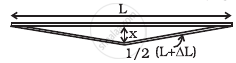
A rail track made of steel having length 10 m is clamped on a raillway line at its two ends (figure). On a summer day due to rise in temperature by 20° C, it is deformed as shown in figure. Find x (displacement of the centre) if αsteel = 1.2 × 10⁻⁵/°C.
A clock with an iron pendulum keeps the correct time at 15°C. If the room temperature is 20°C, the error in seconds per day will be near ______.
(coefficient of linear expansion of iron is 1.2 × 10⁻⁵/°C)
The increase in the dimensions of a body due to an increase in its temperature is called ______.
Which of the following correctly lists the three types of thermal expansion?
A metallic bar of Young’s modulus, 0.5 × 10¹¹ N m−2 and coefficient of linear thermal expansion 10−5°C−1, length 1 m and area of cross-section 10−3 m2 is heated from 0°C to 100°C without expansion of bending. The compressive force developed in it is ______.
