Advertisements
Advertisements
Question
An aluminium sphere is dipped into water. Which of the following is true?
Options
Buoyancy will be less in water at 0°C than that in water at 4°C.
Buoyancy will be more in water at 0°C than that in water at 4°C.
Buoyancy in water at 0°C will be same as that in water at 4°C.
Buoyancy may be more or less in water at 4°C depending on the radius of the sphere.
Advertisements
Solution
Buoyancy will be less in water at 0°C than that in water at 4°C.
Explanation:
Let volume of the sphere is V and ρ is its density, then we can write buoyant force
F = VρG .....(g = acceleration due to gravity)
⇒ F ∝ ρ .....(∵ V and g are almost constant)
⇒ `F_(4^circC)/F_(0^circC) = ρ_(4^circC)/ρ_(0^circC) > 1` .....(∵ ρ4°C > ρ0°C)
⇒ `F_(4^circC) > F_(0^circC)`
Hence, buoyancy will be less in water at 0°C than that in water at 4°C.
APPEARS IN
RELATED QUESTIONS
A hole is drilled in a copper sheet. The diameter of the hole is 4.24 cm at 27.0 °C. What is the change in the diameter of the hole when the sheet is heated to 227 °C? Coefficient of linear expansion of copper = 1.70 × 10⁻⁵ K–1.
A brass rod of length 50 cm and diameter 3.0 mm is joined to a steel rod of the same length and diameter. What is the change in length of the combined rod at 250 °C, if the original lengths are at 40.0 °C? Is there a ‘thermal stress’ developed at the junction? The ends of the rod are free to expand (Co-efficient of linear expansion of brass = 2.0 × 10⁻⁵ K–1, steel = 1.2 × 10⁻⁵ K–1).
If two bodies are in thermal equilibrium in one frame, will they be in thermal equilibrium in all frames?
If mercury and glass had equal coefficients of volume expansion, could we make a mercury thermometer in a glass tube?
If an automobile engine is overheated, it is cooled by pouring water on it. It is advised that the water should be poured slowly with the engine running. Explain the reason.
Is it possible for two bodies to be in thermal equilibrium if they are not in contact?
Answer the following question.
Derive the relation between three coefficients of thermal expansion.
Answer the following question.
Give an example of the disadvantages of thermal stress in practical use?
A glass flask has a volume 1 × 10⁻⁴ m3. It is filled with a liquid at 30°C. If the temperature of the system is raised to 100°C, how much of the liquid will overflow? (Coefficient of volume expansion of glass is 1.2 × 10⁻⁵ (°C)−1 while that of the liquid is 75 × 10−5 (°C)−1).
Solve the following problem.
In olden days, while laying the rails for trains, small gaps used to be left between the rail sections to allow for thermal expansion. Suppose the rails are laid at room temperature 27 °C. If maximum temperature in the region is 45 °C and the length of each rail section is 10 m, what should be the gap left given that α = 1.2 × 10⁻⁵K–1 for the material of the rail section?
Solve the following problem.
A blacksmith fixes iron ring on the rim of the wooden wheel of a bullock cart. The diameter of the wooden rim and the iron ring are 1.5 m and 1.47 m respectively at room temperature of 27 °C. To what temperature the iron ring should be heated so that it can fit the rim of the wheel? (αiron = 1.2 × 10⁻⁵K–1).
A clock pendulum having coefficient of linear expansion. α = 9 × 10⁻⁷/°C-1 has a period of 0.5 s at 20°C. If the clock is used in a climate, where the temperature is 30°C, how much time does the clock lose in each oscillation? (g = constant)
A metre scale made of a metal reads accurately at 25 °C. Suppose in an experiment an accuracy of 0.12 mm in 1 m is required, the range of temperature in which the experiment can be performed with this metre scale is ______.(coefficient of linear expansion of the metal is `20 xx 10^-6 / (°"C")`
A metal rod is heated to t°C. A metal rod has length, area of cross-section, Young's modulus and coefficient of linear expansion as 'L', 'A', 'Y' and 'a' respectively. When the rod is heated, the work performed is ______.
The volume of a metal block changes by 0.86% when heated through 200 °C then its coefficient of cubical expansion is ______.
A rail track made of steel having length 10 m is clamped on a raillway line at its two ends (figure). On a summer day due to rise in temperature by 20° C, it is deformed as shown in figure. Find x (displacement of the centre) if αsteel = 1.2 × 10⁻⁵/°C.
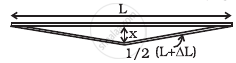
A disc is rotating freely about its axis. The percentage change in angular velocity of a disc if temperature decreases by 20°C is ______.
(coefficient of linear expansion of material of disc is 5 × 10⁻⁴/°C)
Given below are two statements: one is labelled as Assertion A and the other is labelled as Reason R.
- Assertion A: When a rod lying freely is heated, no thermal stress is developed in it.
- Reason R: On heating, the length of the rod increases. In light of the above statements.
choose the correct answer from the options given below:
A clock with an iron pendulum keeps the correct time at 15°C. If the room temperature is 20°C, the error in seconds per day will be near ______.
(coefficient of linear expansion of iron is 1.2 × 10⁻⁵/°C)
