Advertisements
Advertisements
Question
A student records the initial length l, change in temperature ∆T and change in length ∆l of a rod as follows:
| S.No. | l(m) | ∆T (C) | ∆l (m) |
| 1. | 2 | 10 | `4 xx 10^-4` |
| 2. | 1 | 10 | `4 xx 10^-4` |
| 3. | 2 | 20 | `2 xx 10^-4` |
| 4. | 3 | 10 | `6 xx 10^-4` |
If the first observation is correct, what can you say about observations 2, 3 and 4.
Advertisements
Solution
As per the 1st observation, we can infer that linear expansion α is,
α = `(∆l)/(l∆t)`
= `(4 xx 10^-4)/(2 xx 10)`
= `2 xx 10^(-5^circ) C^-1`
For observation no. 2,
α = `(∆l)/(l∆t)`
`∆l = αl∆t`
= `2 xx 10^-5 xx 1 xx 10`
= `2 xx 10^-4 m`
But given value is `∆l = 4 xx 10^-4 m`
So, 2nd observation is incorrect.
For observation no. 3,
α = `(∆l)/(l∆t)`
`∆l = αl∆t`
= `2 xx 10^-5 xx 2 xx 20`
= `8 xx 10^-4 m`
But the given value is `∆l = 2 xx 10^-4 m`
So, 3rd observation is incorrect.
For observation no. 4,
α = `(∆l)/(l∆t)`
`∆l = αl∆t`
= `2 xx 10^-5 xx 3 xx 10`
= `6 xx 10^-4 m`
Here the obtained value is the same as the given value.
So, the 4th observation is correct.
APPEARS IN
RELATED QUESTIONS
A steel tape 1m long is correctly calibrated for a temperature of 27.0 °C. The length of a steel rod measured by this tape is found to be 63.0 cm on a hot day when the temperature is 45.0 °C. What is the actual length of the steel rod on that day? What is the length of the same steel rod on a day when the temperature is 27.0 °C? Coefficient of linear expansion of steel = 1.20 × 10⁻⁵ K–1
If two bodies are in thermal equilibrium in one frame, will they be in thermal equilibrium in all frames?
Is it possible for two bodies to be in thermal equilibrium if they are not in contact?
Show that the moment of inertia of a solid body of any shape changes with temperature as I = I0 (1 + 2αθ), where I0 is the moment of inertia at 0°C and α is the coefficient of linear expansion of the solid.
Answer the following question.
What is thermal stress?
A glass flask has a volume 1 × 10⁻⁴ m3. It is filled with a liquid at 30°C. If the temperature of the system is raised to 100°C, how much of the liquid will overflow? (Coefficient of volume expansion of glass is 1.2 × 10⁻⁵ (°C)−1 while that of the liquid is 75 × 10−5 (°C)−1).
Solve the following problem.
In olden days, while laying the rails for trains, small gaps used to be left between the rail sections to allow for thermal expansion. Suppose the rails are laid at room temperature 27 °C. If maximum temperature in the region is 45 °C and the length of each rail section is 10 m, what should be the gap left given that α = 1.2 × 10⁻⁵K–1 for the material of the rail section?
Solve the following problem.
A blacksmith fixes iron ring on the rim of the wooden wheel of a bullock cart. The diameter of the wooden rim and the iron ring are 1.5 m and 1.47 m respectively at room temperature of 27 °C. To what temperature the iron ring should be heated so that it can fit the rim of the wheel? (αiron = 1.2 × 10⁻⁵K–1).
A metre scale made of a metal reads accurately at 25 °C. Suppose in an experiment an accuracy of 0.12 mm in 1 m is required, the range of temperature in which the experiment can be performed with this metre scale is ______.(coefficient of linear expansion of the metal is `20 xx 10^-6 / (°"C")`
A metal sphere 10.01 cm in diameter is placed on a brass ring of internal diameter 10 cm and at the same temperature of 12° C. The temperature up to which they should be heated together so that the metal sphere just passes through the ring is `[alpha_"metal"= 12 xx 10^-6//°"C" and alpha_"brass" =18 xx 10^-6//°"C"]` ____________.
A metal rod is heated to t°C. A metal rod has length, area of cross-section, Young's modulus and coefficient of linear expansion as 'L', 'A', 'Y' and 'a' respectively. When the rod is heated, the work performed is ______.
A hot body at a temperature 'T' is kept in a surrounding of temperature 'T0'. It takes time 't1' to cool from 'T' to 'T2', time t2 to cool from 'T2' to 'T3' and time 't3' to cool from 'T3' to 'T4'. If (T - T2) = (T2 - T3) = (T3 - T4), then ______.
A metal rod of cross-sectional area 3 × 10⁻⁶ m2 is suspended vertically from one end has a length 0.4 m at 100°C. Now the rod is cooled upto 0°C, but prevented from contracting by attaching a mass 'm' at the lower end. The value of 'm' is ______.
(Y = 1011 N/m2, coefficient of linear expansion = 10-5/K, g = 10m/s2)
The radius of a metal sphere at room temperature T is R, and the coefficient of linear expansion of the metal is α. The sphere is heated a little by a temperature ∆T so that its new temperature is T + ∆T. The increase in the volume of the sphere is approximately ______.
A rail track made of steel having length 10 m is clamped on a raillway line at its two ends (figure). On a summer day due to rise in temperature by 20° C, it is deformed as shown in figure. Find x (displacement of the centre) if αsteel = 1.2 × 10⁻⁵/°C.
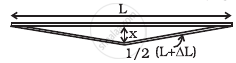
At what temperature a gold ring of diameter 6.230 cm be heated so that it can be fitted on a wooden bangle of diameter 6.241 cm? Both diameters have been measured at room temperature (27°C). (Given: coefficient of linear thermal expansion of gold αL = 1.4 × 10⁻⁵ K-1).
If the length of a cylinder on heating increases by 2%, the area of its base will increase by ______.
The height of mercury column measured with brass scale at temperature T0 is H0. What height H' will the mercury column have at T = 0°C. Coefficient of volume expansion of mercury is γ. Coefficient of linear expansion of brass is α ______.
A metal rod Y = 2 × 10¹² dyne cm-2 of coefficient of linear expansion 1.6 × 10⁻⁵ per °C has its temperature raised by 20°C. The linear compressive stress to prevent the expansion of the rod is ______.
Which of the following correctly lists the three types of thermal expansion?
