Advertisements
Advertisements
Question
Will the value of specific heat’capacity and specific latent heat of a substance change if the scale is °F instead of °C?
Advertisements
Solution
The specific heat capacity will change if the scale is °F instead of °C. This is because it is the heat needed to raise the temperature of a unit of the substance by one degree. Since the size of the Fahrenheit degee is not the same as that of the celsium degree, a change of scale will affect the specific heat capacity.
The specific latent heat will not change with a change of scale. This is because this quantity is simply the heat needed to change the state of 1 kg of a substance at its melting/boiling point without any change in temperature. It is thus heat per unit mass and does not depends upon the scale of temperature used.
RELATED QUESTIONS
Give a mathematical relation between Heat Capacity and Specific Heat Capacity.
What do you mean by the following statement?
The specific heat capacity of copper is 0. 4 Jg-1 K-1?
What change in heat energy occurs when lead at its melting point
solidifies without change in the temperature?
Explain, why water is considered as best liquid for quenching thirst?
A substance is in the form of a solid at 0°C. The amount of heat added to this substance and the temperature of the substance are plotted on the following graph:
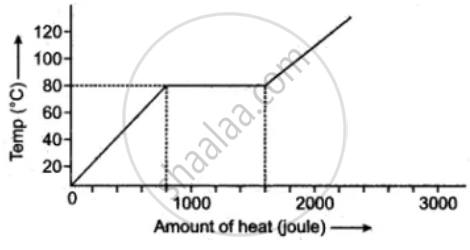
If the specific heat capacity of the solid substance is 500 J/kg °G, find from the graph, the mass of the substance.
Calculate the amount of heat released when 5.0 g of water at 20°C is changed into ice at 0°C.
(Specific heat capacity of water = 4.2 J/g°C
Specific latent heat of fusion of ice = 336 J/g)
Numerical Problem.
What is the heat in joules required to raise the temperature of 25 grams of water from 0°C to 100°C? What is the heat in Calories? (Specific heat of water = `(4.18"J")/("g"°"C")`
50 g of copper is heated to increase its temperature by 10° C. If the same quantity of heat is given to 5 g water, the rise in its temperature is [Specific heat of copper = 420 joule-kg-1 °C-1 , specific heat of water = 4200 joule-kg-I °C-1]
A monoatomic gas of pressure 'P' having volume 'V' expands isothermally to a volume '2V' and then adiabatically to a volume '16V'. The final pressure of the gas is ______.
(ratio of specific heats = `5/3`)
