Advertisements
Advertisements
Question
A calorimeter has mass 100 g and specific heat 0.1 kcal/ kg°C. It contains 250 gm of liquid at 30°C having specific heat of 0.4 kcal/kg°C. If we drop a piece of ice of mass 10 g at 0°C, What will be the temperature of the mixture?
Advertisements
Solution
Let the final temperature of the mixture be T.
Amount of heat required in converting 10 g ice to 0°C to water at 0°C = 10 × 80 = 800 cal
Total amount of heat required in converting 10 g water to 0°C to water at T°C = 10 × 1 × T = 10T
Total heat energy required to convert 10 g ice at 0°C to water at T°C = 800 + 10T
Amount of heat released to raise the temperature of calorimeter at 30°C to T°C = 100 × 0.1 × (30 − T) = 10(30 − T)
Amount of heat released to raise the temperature of 250g of water at 30°C to T°C = 250 × 0.4 × (30 − T) = 100(30 − T)
Total amount of heat released in the process = 110(30 − T)
Using the principle of the calorimeter, we have
110(30 − T) = 800 + 10T
APPEARS IN
RELATED QUESTIONS
A geyser heats water flowing at the rate of 3.0 litres per minute from 27 °C to 77 °C. If the geyser operates on a gas burner, what is the rate of consumption of the fuel if its heat of combustion is 4.0 × 10⁴ J/g?
A solid metal weighing 150 g melts at its melting point of 800 °C by providing heat at the rate of 100 W. The time taken for it to completely melt at the same temperature is 4 min. What is the specific latent heat of fusion of the metal?
Give one example where high specific heat capacity of water is used as heat reservoir ?
Who shall pay carbon tax ?
In Regnault's apparatus for measuring specific heat capacity of a solid, there is an inlet and an outlet in the steam chamber. The inlet is near the top and the outlet is near the bottom. Why is it better than the opposite choice where the inlet is near the bottom and the outlet is near the top?
A substance is heated at a constant rate from a low temperature to a high temperature. A graph of temperature against time is shown in the figure. Which part or parts of the graph correspond(s) to the substance existing in two states?
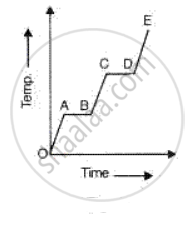
Explain, Why is it advisabile to pour cold water over burns, caused on human body, by hot solids?
Some heat is provided to a body to raise its temperature by 25°C. What will be the corresponding rise in temperature of the body as shown on the Kelvin scale?
Discuss how high specific heat capacity of water helps in formation of land and sea breeze.
A piece of ice is heated at a constant rate. The variation of temperature with heat input is shown in the graph below:

(i) What are represented by AB and CD?
(ii) What conclusion can you draw regarding the 110°c nature of ice from the above graph?
_______ is defined as the amount of heat required to raise the temperature of 1kg of a substance by 1°C.
The heat capacity of the vessel of mass 100 kg is 8000 J/°K. Find its specific heat capacity.
What is specific heat capacity?
Numerical Problem.
What could be the final temperature of a mixture of 100 g of water at 90 °C and 600g of water at 20°C.
When a uniform rod is heated, which of the following quantity of the rod will increase
Derive Meyer’s relation for an ideal gas.
If 'Cp' and 'Cv' are molar specific heats of an ideal gas at constant pressure and volume respectively. If 'λ' is the ratio of two specific heats and 'R' is universal gas constant then 'Cp' is equal to ______.
Conductors have generally high specific heat capacities and insulators have low specific heat capacities.
Two cylinders of equal height and radius are made of copper and aluminum. Which of them conducts heat faster?
