Advertisements
Advertisements
प्रश्न
The temperature of a lead piece of mass 400 g rises from 20°C to 50°C when 1560 J of heat is supplied to it. Calculate: Heat capacity of lead piece.
Advertisements
उत्तर
Heat capacity of lead piece
= `"Heat supplied"/"Rise in temperature" = (1560 "J")/(50 - 20^circ "C")` = 52 J/° C.
संबंधित प्रश्न
What do you understand by the following statements:
The heat capacity of the body is 60JK-1.
Give one example where high specific heat capacity of water is used as cooling purposes?
Indian style of cooling drinking water is to keep it in a pitcher having porous walls. Water comes to the outer surface very slowly and evaporates. Most of energy needed for evaporation is taken from the water itself and the water is cooled down. Assume that a pitcher contains 10 kg of water and 0.2 g of water comes out per second. Assuming no backward heat transfer from the atmosphere to the water, calculate the time in which the temperature decrease by 5°C. Specific heat capacity of water = 4200 J kg−1 °C−1 and latent heat of vaporization of water = 2.27 × 10⁶ J kg−1.
A substance is heated at a constant rate from a low temperature to a high temperature. A graph of temperature against time is shown in the figure. Which part or parts of the graph correspond(s) to the substance existing in two states?
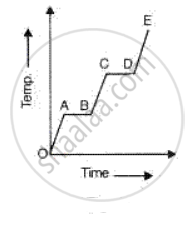
(b) 2000 J of heat energy is required to raise the temperature of 4 kg of a
metal by 3°c. Which expression gives the specific heat capacity of the metal?
Explain why the specific heat capacity at constant pressure is greater than the specific heat capacity at constant volume.
Which of the following substances (A, B and C) has the highest specific beat?
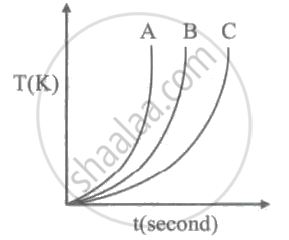
Which of the substances P, Q, or R has the lowest specific heat? The temperature v/s time graph is shown ______.

When two kilocalories of heat are supplied to a system, the internal energy of the system increases by 5030 J and the work done by the gas against the external pressure is 3350 J. Calculate J, the mechanical equivalent of heat.
Which method is used to determine the specific heat capacity of both solids and liquids by mixing a substance of unknown specific heat with water?
