Advertisements
Advertisements
Question
A solid of mass 50 g at 150 °C is placed in 100 g of water at 11 °C when the final temperature recorded is 20 °C. Find the specific heat capacity of the solid. (specific heat capacity of water = 4.2 J/g °C)
Advertisements
Solution
Mass of the solid, ms = 50 g
Initial temperature of the solid, ts = 150C
Mass of water, mw = 100 g
Temperature of water, tw = 11°C
Final temperature of the mixture, t = 20°C
According to the principle of calorimetry
Heat gained by water = Heat lost by the solid
`:.m_wc_w(t - t_w) = m_sc_s(t_s - t)`
∴ 100 x 4.2 x (20 - 10) = 50 x cs x (150 - 20)
3780 = 6500cs
`:. c_s = 3780/6500 = 0.581` J/g °C
APPEARS IN
RELATED QUESTIONS
It is generally cold after a hail-storm then during and before the hail storm. Give reason.
What is the specific heat capacity of melting ice?
104g of water at 30°C is taken in a calorimeter made of copper of mass 42 g. When a certain mass of ice at 0°C is added to it, the final steady temperature of the mixture after the ice has melted, was found to be 10°C. Find the mass of ice added. [Specific heat capacity of water = 4.2 Jg–1°C–1 ; Specific latent heat of fusion of ice = 336 Jg–1; Specific heat capacity of copper = 0.4 Jg–1°C–1] .
A liquid X has specific heat capacity higher than the liquid Y. Which liquid is useful as heat reservoir to keep juice bottles without freezing?
_______ is defined as the amount of heat required to raise the temperature of 1kg of a substance by 1°C.
Define specific heat capacity.
A diatomic gas undergoes adiabatic change. Its pressure 'P' and temperature 'T' are related as p ∝ Tx, where x is ______.
Two uniform brass rods A and B of length land 2l and radii 2r and r respectively are heated to the same temperature. The ratio of the increase in the volume ofB to that of A is ____________.
The diagram below shows a cooling curve for 200 g of water. The heat is extracted at the rate of 100 Js-1. Answer the questions that follow:
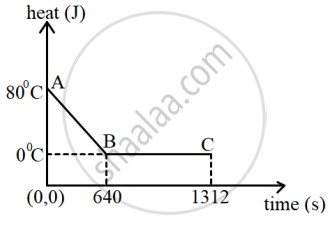
- Calculate specific heat capacity of water.
- Heat released in the region BC.
