Advertisements
Advertisements
Question
Advertisements
Solution
m = 100 g
C = 0.04 cal g-1 °C-1
Heat capacity = m x C = 4 cal °C-1
APPEARS IN
RELATED QUESTIONS
A solid of mass 50 g at 150 °C is placed in 100 g of water at 11 °C when the final temperature recorded is 20 °C. Find the specific heat capacity of the solid. (specific heat capacity of water = 4.2 J/g °C)
Water in lakes and ponds do not freeze at once in cold countries. Give a reason is support of your answer.
What do you mean by the following statement?
The heat capacity of a body is 50 JK-1?
Water is used in hot water bottles for fomentation. Give a reason.
State the effect of enhancement of green house effect.
Name and state the principle used to measure the specific heat capacity of a substance.
Explain, why does a wise farmer water his fields, if forecast is forst?
A substance is in the form of a solid at 0°C. The amount of heat added to this substance and the temperature of the substance are plotted on the following graph:
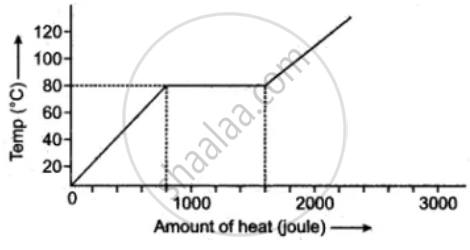
If the specific heat capacity of the solid substance is 500 J/kg °G, find from the graph, the mass of the substance.
The heat capacity of the vessel of mass 100 kg is 8000 J/°K. Find its specific heat capacity.
A block of ice of mass 120 g at temperature 0°C is put in 300 gm of water at 25°C. The xg of ice melts as the temperature of the water reaches 0°C. The value of x is ______.
[Use: Specific heat capacity of water = 4200 Jkg-1K-1, Latent heat of ice = 3.5 × 10⁵ Jkg-1]
