Advertisements
Advertisements
प्रश्न
Solve the following example.
Two tungsten bulbs of wattage 100 W and 60 W power work on 220 V potential difference. If they are connected in parallel, how much current will flow in the main conductor?
Advertisements
उत्तर १
Power of first bulb, P1 = 100 W
Power of second bulb, P2 = 60 W
Now,
Resistance of first bulb, `R_1 = (V^2)/(P_1)=(220xx220)/100 = 484 Ω`
When the bulbs are connected in parallel, their equivalent resistance is
उत्तर २
Potential remains same in the resistors when they are connected in the parallel.
∴ Potential in both the bulbs will be same.
Now,
For First Tungsten Bulb,
Power = 100 W.
Potential = 220 V.
∵ Power = Potential × Current.
∴ Current = 100/220
⇒ Current = 0.45 A.
For second Tungsten bulbs,
Power = 60 W.
Potential = 220 V.
∴ Current = 60/220
= 0.27 A.
Now, Total current flowing = Current in 1st bulb + Current in 2nd bulb.
= 0.45 + 0.27
= 0.72 A.
Hence, the total current flowing in the main conductor is 0.72 A.
APPEARS IN
संबंधित प्रश्न
Compute the heat generated while transferring 96000 coulomb of charge in one hour through a potential difference of 50 V.
Why is the tungsten used almost exclusively for filament of electric lamps?
Why are the conductors of electric heating devices, such as bread-toasters and electric irons, made of an alloy rather than a pure metal?
An electric heater is connected to the 230 V mains supply. A current of 8 A flows through the heater.
- How much charge flows around the circuit each second?
- How much energy is transferred to the heater each second?
Why are the coils of electric irons and electric toasters made of an alloy rather than a pure metal?
An electric kettle rated at 220 V, 2.2 kW, works for 3 hours. Find the energy consumed and the current drawn.
Why does the connecting cord of an electric heater not glow hot while the heating element does?
Write down the formula for the heat produced when a current I is passed through a resistor R for time t.
Explain why, tungsten is used for making the filaments of electric bulbs.
Name the material which is used for making the filaments of an electric bulb.
The current passing through an electric kettle has been doubled. The heat produced will become:
(a) half
(b) double
(c) four time
(d) one-fourth
The elements of electrical heating devices are usually made of:
(a) tungsten
(b) bronze
(c) nichrome
(d) argon
Which of the following characteristic is not suitable for a fuse wire?
(a) thin and short
(b) thick and short
(c) low melting point
(d) higher resistance than rest of wiring
Two exactly similar heating resistances are connected (i) in series, and (ii) in parallel, in two different circuits, one by one. If the same current is passed through both the combinations, is more heat obtained per minute when they are connected in series or when they are connected in parallel? Give reason for your answer.
Heat energy is being produced in a resistance in a circuit at the rate of 100 W. The current of 3 A is flowing in the circuit. What must be the value of the resistance?
Name the factors on which the heat produced in a wire depends when current is passed in it, and state how does it depend on the factors stated by you.
Write two devices based on the heating effect of electric current.
Right or wrong sentence.
Live wire and neutral wires have a 220 V potential difference.
Name any two appliances which works on the phenomenon of heating effect of electric current.
When does overloading occur?
What does overloading cause?
Explain the heating effect of electric current.
Name any two appliances which work under the principle of heating effect of current.
Which of the following gases are filled in electric bulbs?
An electric kettle consumes 1 kW of electric power when operated at 220 V. A fuse wire of what rating must be used for it?
Unscramble the following words:
SFEU
What is an electric fuse made up of?
______ wire is used in the filament of the bulbs.
Match the following
| 1. | Bulb | a. | Conductor |
| 2. | Electroplating | b. |
Insulator |
| 3. | Pure water | c. | Heating effect of current |
| 4. | Salt solution | d. | Chemical effect of current |
An electric fuse is a wire made up of a material having ______ melting point.
1 kWh is equal to ______.
Two students decided to investigate the effect of water and air on iron object under identical experimental conditions. They measured the mass of each object before placing it partially immersed in 10 ml of water. After a few days, the object were removed, dried and their masses were measured. The table shows their results.
| Student | Object | Mass of Object before Rusting in g |
Mass of the coated object in g |
| A | Nail | 3.0 | 3.15 |
| B | Thin plate | 6.0 | 6.33 |
What might be the reason for the varied observations of the two students?
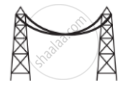
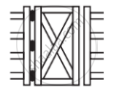
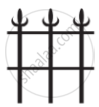
In which of the following applications of Iron, rusting will occur most? Support your answer with valid reason.
| A | B | C | D |
 |
 |
 |
 |
Write an expression for the amount of heat produced in a resistor when an electric current is passed through it stating the meanings of the symbols used.
State the law that explains the heating effect of current with respect to the measurable properties in an electrical circuit.
When a current I flows through a wire of resistance R for time t then the electrical energy produced is given by ______.
