Advertisements
Advertisements
प्रश्न
Solve the following example.
Two tungsten bulbs of wattage 100 W and 60 W power work on 220 V potential difference. If they are connected in parallel, how much current will flow in the main conductor?
Advertisements
उत्तर १
Power of first bulb, P1 = 100 W
Power of second bulb, P2 = 60 W
Now,
Resistance of first bulb, `R_1 = (V^2)/(P_1)=(220xx220)/100 = 484 Ω`
When the bulbs are connected in parallel, their equivalent resistance is
उत्तर २
Potential remains same in the resistors when they are connected in the parallel.
∴ Potential in both the bulbs will be same.
Now,
For First Tungsten Bulb,
Power = 100 W.
Potential = 220 V.
∵ Power = Potential × Current.
∴ Current = 100/220
⇒ Current = 0.45 A.
For second Tungsten bulbs,
Power = 60 W.
Potential = 220 V.
∴ Current = 60/220
= 0.27 A.
Now, Total current flowing = Current in 1st bulb + Current in 2nd bulb.
= 0.45 + 0.27
= 0.72 A.
Hence, the total current flowing in the main conductor is 0.72 A.
APPEARS IN
संबंधित प्रश्न
An electric heater of resistance 8 Ω draws 15 A from the service mains 2 hours. Calculate the rate at which heat is developed in the heater.
An electric room heater draws a current of 2.4 A from the 120 V supply line. What current will this room heater draw when connected to 240 V supply line?
What is nichrome? State its one use.
Why is a series arrangement not used for connecting domestic electrical appliances in a circuit?
Explain why, the current that makes the heater element very hot, only slightly warms the connecting wires leading to the heater.
The heat produced by passing an electric current through a fixed resistor is proportional to the square of:
(a) magnitude of resistance of the resistor
(b) temperature of the resistor
(c) magnitude of current
(d) time for which current is passed
The current passing through an electric kettle has been doubled. The heat produced will become:
(a) half
(b) double
(c) four time
(d) one-fourth
An electric fuse works on the:
(a) chemical effect of current
(b) magnetic effect of current
(c) lighting effect of current
(d) heating effect of current
The heat produced in a wire of resistance 'x' when a current 'y' flows through it in time 'z' is given by:
(a) x2 × y × z
(b) x × z × y2
(c) y × z2 × x
(d) y × z × x
The electrical resistivities of four materials P, Q, R and S are given below:
| P | `6.84xx10^8`Ωm |
| Q | `1.70xx10^8`Ωm |
| R | ` 1.0xx10^15`Ωm |
| s | `11.0xx10^-7`Ωm |
Which material will you use for making: (a) heating element of electric iron (b) connecting wires of electric iron (c) covering of connecting wires? Give reason for your choice in each case.
An electric iron of 1100 W is operated for 2 hrs daily. What will be the electrical consumption expenses for that in the month of April? (The electric company charges Rs 5 per unit of energy).
Why does tungsten metal used to make solenoid type coil in an electric bulb?
Give scientific reason :
In the electric equipment producing heat e.g. iron, electric heater, boiler, toaster, etc., an alloy such as Nichrome is used, not pure metals.
Rewrite the following statement by selecting the correct option:
1 A = ____________ mA.
The electricity bill specifies the usage in _______.
Find the odd one out and give its explanation.
Write two devices based on the heating effect of electric current.
Right or wrong sentence.
Live wire and neutral wires have a 220 V potential difference.
Explain the importance/uses of fuse wire.
When does overloading occur?
How can overloading be avoided?
Name some devices that run using heat effect of electric current
Name any two appliances which work under the principle of heating effect of current.
A current of 1 A is drawn by a filament of an electric bulb. Number of electrons passing through a cross-section of the filament in 16 seconds would be roughly:
An electric kettle consumes 1 kW of electric power when operated at 220 V. A fuse wire of what rating must be used for it?
An electric component used as a safety device is electric circuit is ______.
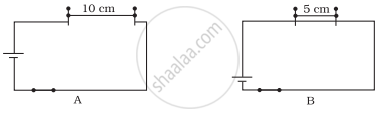
Paheli took a wire of length 10 cm. Boojho took a wire of 5 cm of the same material and thickness. Both of them connected the wires as shown in the circuit given in the following figure. The current flowing in both the circuits is the same.
- Will the heat produced in both cases be equal? Explain.
- Will the heat produced be the same if the wires taken by them are of equal lengths but of different thickness? Explain.
What are the factors affecting heating effect of electric current?
Explain the working of an electric fuse.
______ wire is used in the filament of the bulbs.
A student boils water in an electric kettle for 20 minutes. Using the same mains supply he wants to reduce the boiling time of water. To do so should he increase or decrease the length of the heating element? Justify your answer.
The following is not a safety device.
A trip switch is a ______ safety device.
Explain why fuse wire is always connected in a series arrangement.
An electric kettle of 2 kW is used for 2h. Calculate the energy consumed in
- kilowatt hour and
- joules.
Anannya responded to the question: Why do electrical appliances with metallic bodies are connected to the mains through a three-pin plug, whereas an electric bulb can be connected with a two-pin plug?
She wrote: Three-pin connections reduce heating of connecting wires.
- Is her answer correct or incorrect? Justify.
- What is the function of a fuse in a domestic circuit?
The graph of voltage vs current for four different materials is shown below.

Which of these four materials would be used for making filament of bulb?
