Advertisements
Advertisements
प्रश्न
Write two devices based on the heating effect of electric current.
Name any three appliances based on the heating effect of electric current.
Advertisements
उत्तर
Fuse wire, electric iron, electric bulb, electric cooker, geyser.
APPEARS IN
संबंधित प्रश्न
State four most common electrical appliances based on heating effect of electric current. Why do we use finely heated platinum wire in surgery?
An electric heater of resistance 8 Ω draws 15 A from the service mains 2 hours. Calculate the rate at which heat is developed in the heater.
Why is the tungsten used almost exclusively for filament of electric lamps?
Why are the conductors of electric heating devices, such as bread-toasters and electric irons, made of an alloy rather than a pure metal?
Write Joule's law of heating.
An electric heater is connected to the 230 V mains supply. A current of 8 A flows through the heater.
(b) How much energy is transferred to the heater each second?
What is nichrome? State its one use.
Write down the formula for the heat produced when a current I is passed through a resistor R for time t.
An electric iron of resistance 20 ohms draws a current of 5 amperes. Calculate the heat produced in 30 seconds.
Explain why, the current that makes the heater element very hot, only slightly warms the connecting wires leading to the heater.
How much heat will an instrument of 12 W produce in one minute if it is connected to the heat produced by it?
The current passing through a room heater has been halved. What will happen to the heat produced by it?
Name the material which is used for making the filaments of an electric bulb.
The elements of electrical heating devices are usually made of:
(a) tungsten
(b) bronze
(c) nichrome
(d) argon
Which of the following characteristic is not suitable for a fuse wire?
(a) thin and short
(b) thick and short
(c) low melting point
(d) higher resistance than rest of wiring
If the current flowing through a fixed resistor is halved, the heat produced in it will become:
The electrical resistivities of four materials P, Q, R and S are given below:
| P | `6.84xx10^8`Ωm |
| Q | `1.70xx10^8`Ωm |
| R | ` 1.0xx10^15`Ωm |
| s | `11.0xx10^-7`Ωm |
Which material will you use for making: (a) heating element of electric iron (b) connecting wires of electric iron (c) covering of connecting wires? Give reason for your choice in each case.
Two exactly similar heating resistances are connected (i) in series, and (ii) in parallel, in two different circuits, one by one. If the same current is passed through both the combinations, is more heat obtained per minute when they are connected in series or when they are connected in parallel? Give reason for your answer.
Three heaters each rated 250 W, 100 V are connected in parallel to a 100 V supply. Calculate:
- the total current taken from the supply
- the resistance of each heater and
- the energy supplied in kWh to the three heaters in 5 hours.
Identify the figure and give its use.
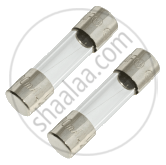
Answer the following question:
what is the heating effect of the electric current? state any four applications of it?
Write the mathematical expression for Joule’s law of heating.
In an electric bulb, coil of _______ metal is used.
The electricity bill specifies the usage in _______.
These days when current in the circuit suddenly increases _______ switches are used.
What is the heating effect of electric current?
Which metal is used to make the filament of an electric bulb?
Right or wrong sentence.
Live wire and neutral wires have a 220 V potential difference.
Write scientific reason.
A coil made up of alloy Nichrome is used in the electric heater cooker as a resistor.
Name any two appliances which works on the phenomenon of heating effect of electric current.
Explain the importance/uses of fuse wire.
What does overloading cause?
Mark the correct choice
- Assertion: Electric appliances with a metallic body have three wire connections.
- Reason: Three-pin connections reduce the heating of the connecting wires.
An electric kettle consumes 1 kW of electric power when operated at 220 V. A fuse wire of what rating must be used for it?
(a) Observe the diagram given below and state whether the bulb will glow or not when we switch on K.
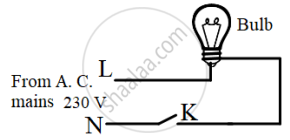
(b) Is it safe to handle the bulb when the switch is OFF?
(c) Give a reason for your answer in (b).
An electric component used as a safety device is electric circuit is ______.
Unscramble the following words:
SFEU
Your teacher has shown you the following activity.
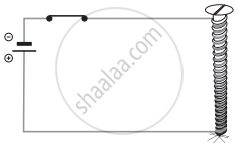
Activity: Teacher has wound a long insulated piece of wire around an iron nail in the form of a coil. Free ends of the wire are connected to a cell through a switch as shown in the following figure. The current is switched on and some pins are placed near the ends of the nail.
Write down any three questions that come to your mind about this activity.
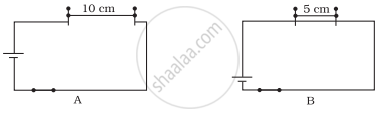
Paheli took a wire of length 10 cm. Boojho took a wire of 5 cm of the same material and thickness. Both of them connected the wires as shown in the circuit given in the following figure. The current flowing in both the circuits is the same.
- Will the heat produced in both cases be equal? Explain.
- Will the heat produced be the same if the wires taken by them are of equal lengths but of different thickness? Explain.
______ wire is used in the filament of the bulbs.
An electric fuse is a wire made up of a material having ______ melting point.
A trip switch is a ______ safety device.
Define the following:
Electrolyte
Tara, after completing her exams, went to her grandmother's house along with her younger brother Rahul. One day, Rahul came home after playing and switched on the fan and air conditioner. At the same time, his grandmother was preparing a milkshake for him using a mixer. Suddenly, they heard a big sound and the electricity of the house got shut down. Tara is called an electrician. He said the main reason for supply to shut down was overloading.
- What is overloading?
- Is overloading and short the same? When does short-circuiting take place?
- How can the effects of overloading be avoided?
In a set up the students coated iron nails with zinc metal and noted that, iron nails coated with zinc prevents rusting. They also observed that zinc initially acts as a physical barrier, but an extra advantage of using zinc is that it continues to prevent rusting even if the layer of zinc is damaged. Name this process of rust prevention and give any two other methods to prevent rusting.
An electric iron of resistance 20 Ω draws a current of 5 A. The heat developed in the iron in 30 seconds is ______.
