Advertisements
Advertisements
प्रश्न
Identify the figure and give its use.
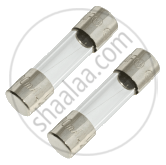
Identify a figure and write one use of it:
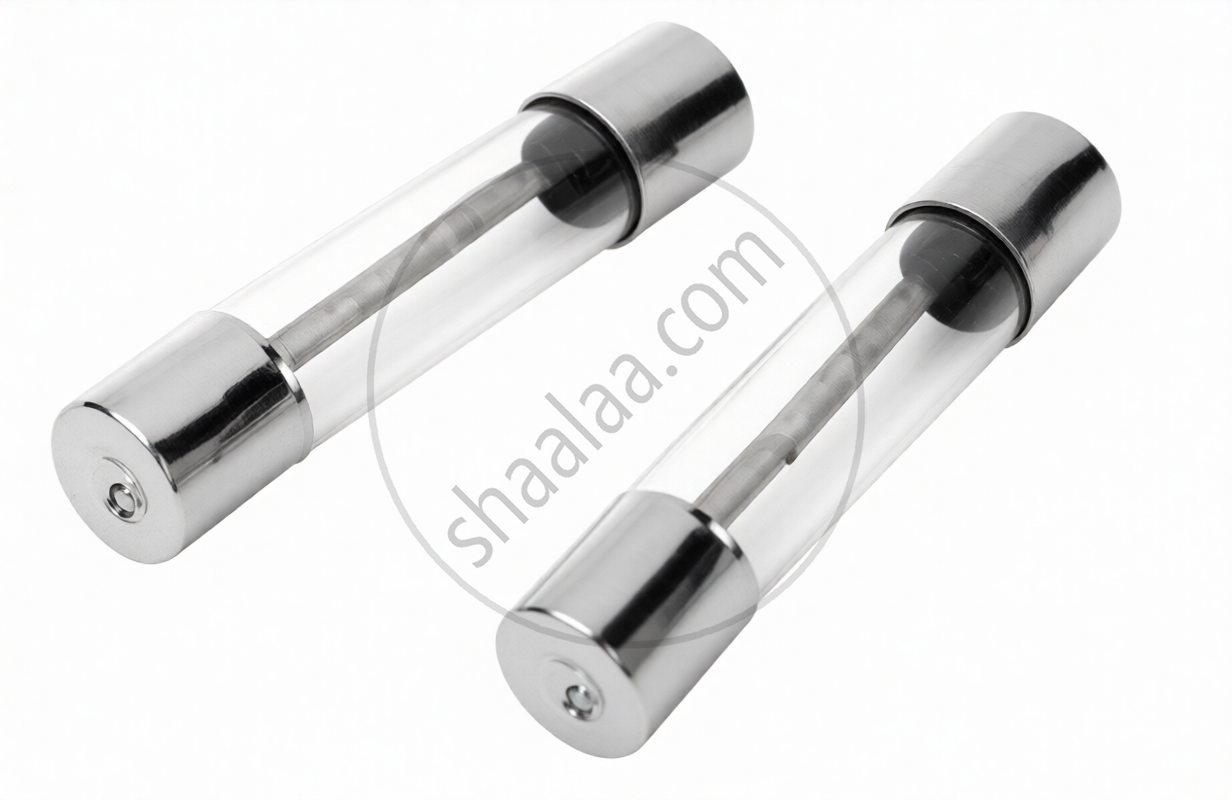
Advertisements
उत्तर
Figure: Cartridge type fuse/Electric fuse
Uses:
- It is a safety device that protects the wiring from overheating caused by an excessive current supply.
- It melts when a high current travels through the circuit, causing the circuit to break and the current to stop flowing through it.
APPEARS IN
संबंधित प्रश्न
How does the resistance of a wire vary with its area of cross-section?
The safety device based on the heating effect of electric current is called a ______.
Write Joule's law of heating.
An electric heater is connected to the 230 V mains supply. A current of 8 A flows through the heater.
(b) How much energy is transferred to the heater each second?
An electric room heater draws a current of 2.4 A from the 120 V supply line. What current will this room heater draw when connected to 240 V supply line?
Give two reasons why nichrome alloy is used for making the heating elements of electrical appliances.
Write down the formula for the heat produced when a current I is passed through a resistor R for time t.
Explain why, the current that makes the heater element very hot, only slightly warms the connecting wires leading to the heater.
Derive the expression for the heat produced due to a current 'I' flowing for a time interval 't' through a resistor 'R' having a potential difference 'V' across its ends. With which name is this relation known?
The heat produced in a wire of resistance 'x' when a current 'y' flows through it in time 'z' is given by:
(a) x2 × y × z
(b) x × z × y2
(c) y × z2 × x
(d) y × z × x
If the current flowing through a fixed resistor is halved, the heat produced in it will become:
Three heaters each rated 250 W, 100 V are connected in parallel to a 100 V supply. Calculate:
- the total current taken from the supply
- the resistance of each heater and
- the energy supplied in kWh to the three heaters in 5 hours.
Give a scientific reason.
Tungsten metal is used to make a solenoid type coil in an electric bulb.
Heat energy is being produced in a resistance in a circuit at the rate of 100 W. The current of 3 A is flowing in the circuit. What must be the value of the resistance?
An electric iron of 1100 W is operated for 2 hrs daily. What will be the electrical consumption expenses for that in the month of April? (The electric company charges Rs 5 per unit of energy).
Statement 1 : Electric current ( flow of electrons ) creates heat in the resistor.
Statement 2 : Heat in the resistor is created according to the rule of energy conservation.
Explain Statement 1 with the help of Statement 2.
Answer the following question:
what is the heating effect of the electric current? state any four applications of it?
Write the mathematical expression for Joule’s law of heating.
Which of the following substance contracts on heating?
Right or wrong sentence.
Live wire and neutral wires have a 220 V potential difference.
Write scientific reason.
A coil made up of alloy Nichrome is used in the electric heater cooker as a resistor.
Name any two appliances which works on the phenomenon of heating effect of electric current.
Explain the importance/uses of fuse wire.
Define fuse.
Explain the heating effect of electric current.
Name any two appliances which work under the principle of heating effect of current.
An electric kettle consumes 1 kW of electric power when operated at 220 V. A fuse wire of what rating must be used for it?
Three incandescent bulbs of 100 W each are connected in series in an electric circuit. In another circuit another set of three bulbs of the same wattage are connected in parallel to the same source.
- Will the bulb in the two circuits glow with the same brightness? Justify your answer.
- Now let one bulb in both the circuits get fused. Will the rest of the bulbs continue to glow in each circuit? Give reason.
What is Joule’s heating effect? How can it be demonstrated experimentally? List its four applications in daily life.
An electric component used as a safety device is electric circuit is ______.
Unscramble the following words:
SFEU
Can we use the same fuse in a geyser and a television set? Explain.
______ wire is used in the filament of the bulbs.
The following is not a safety device.
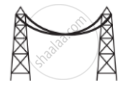
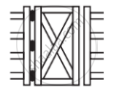
In which of the following applications of Iron, rusting will occur most? Support your answer with valid reason.
| A | B | C | D |
 |
 |
 |
 |
An electric kettle consumes 1 kW of electric power when operated at 220 V. A fuse wire of what rating must be used for it?
The graph of voltage vs current for four different materials is shown below.

Which of these four materials would be used for making filament of bulb?
