Advertisements
Advertisements
प्रश्न
Answer the following question:
what is the heating effect of the electric current? state any four applications of it?
Advertisements
उत्तर
APPEARS IN
संबंधित प्रश्न
An electric iron of resistance 20 Ω takes a current of 5 A. Calculate the heat developed in 30 s.
Why is the tungsten used almost exclusively for filament of electric lamps?
Name any two effects of electric current.
An electric heater is connected to the 230 V mains supply. A current of 8 A flows through the heater.
(b) How much energy is transferred to the heater each second?
An electric iron of resistance 20 ohms draws a current of 5 amperes. Calculate the heat produced in 30 seconds.
Explain why, tungsten is used for making the filaments of electric bulbs.
Name the material which is used for making the filaments of an electric bulb.
An electric fuse works on the:
(a) chemical effect of current
(b) magnetic effect of current
(c) lighting effect of current
(d) heating effect of current
The elements of electrical heating devices are usually made of:
(a) tungsten
(b) bronze
(c) nichrome
(d) argon
Heat energy is being produced in a resistance in a circuit at the rate of 100 W. The current of 3 A is flowing in the circuit. What must be the value of the resistance?
Name the factors on which the heat produced in a wire depends when current is passed in it, and state how does it depend on the factors stated by you.
Compute the heat generated while transferring 96000 coulombs of charge in two hours through a potential difference of 40 V.
The ‘live’ and the ‘neutral’ wires have potential difference of _______.
What is overloading?
Name any two appliances which works on the phenomenon of heating effect of electric current.
Explain the importance/uses of fuse wire.
When does overloading occur?
How can overloading be avoided?
Define fuse.
Mark the correct choice
- Assertion: Electric appliances with a metallic body have three wire connections.
- Reason: Three-pin connections reduce the heating of the connecting wires.
How does use of a fuse wire protect electrical appliances?
An electric cell produces electricity from the ______ ______ in it.
Can we use the same fuse in a geyser and a television set? Explain.
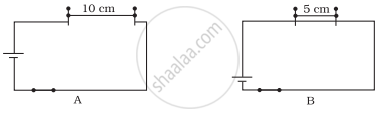
Paheli took a wire of length 10 cm. Boojho took a wire of 5 cm of the same material and thickness. Both of them connected the wires as shown in the circuit given in the following figure. The current flowing in both the circuits is the same.
- Will the heat produced in both cases be equal? Explain.
- Will the heat produced be the same if the wires taken by them are of equal lengths but of different thickness? Explain.
An electric fuse has a body made of ceramic and two points for connecting the fuse wire.
What is an electric fuse made up of?
Match the following
| 1. | Bulb | a. | Conductor |
| 2. | Electroplating | b. |
Insulator |
| 3. | Pure water | c. | Heating effect of current |
| 4. | Salt solution | d. | Chemical effect of current |
Tara, after completing her exams, went to her grandmother's house along with her younger brother Rahul. One day, Rahul came home after playing and switched on the fan and air conditioner. At the same time, his grandmother was preparing a milkshake for him using a mixer. Suddenly, they heard a big sound and the electricity of the house got shut down. Tara is called an electrician. He said the main reason for supply to shut down was overloading.
- What is overloading?
- Is overloading and short the same? When does short-circuiting take place?
- How can the effects of overloading be avoided?
1 kWh is equal to ______.
In the electric equipment producing heat like iron, electric heater, boiler, toaster etc., an alloy such as nichrome is used, not pure metals.
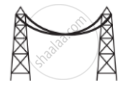
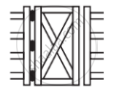
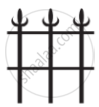
In which of the following applications of Iron, rusting will occur most? Support your answer with valid reason.
| A | B | C | D |
 |
 |
 |
 |
In a set up the students coated iron nails with zinc metal and noted that, iron nails coated with zinc prevents rusting. They also observed that zinc initially acts as a physical barrier, but an extra advantage of using zinc is that it continues to prevent rusting even if the layer of zinc is damaged. Name this process of rust prevention and give any two other methods to prevent rusting.
Write an expression for the amount of heat produced in a resistor when an electric current is passed through it stating the meanings of the symbols used.
When a current I flows through a wire of resistance R for time t then the electrical energy produced is given by ______.
The graph of voltage vs current for four different materials is shown below.

Which of these four materials would be used for making filament of bulb?
