Advertisements
Advertisements
Question
Answer the following question:
what is the heating effect of the electric current? state any four applications of it?
Advertisements
Solution
APPEARS IN
RELATED QUESTIONS
Name any two effects of electric current.
An electric heater is connected to the 230 V mains supply. A current of 8 A flows through the heater.
- How much charge flows around the circuit each second?
- How much energy is transferred to the heater each second?
An electric heater is connected to the 230 V mains supply. A current of 8 A flows through the heater.
(b) How much energy is transferred to the heater each second?
Why is a series arrangement not used for connecting domestic electrical appliances in a circuit?
An electric kettle rated at 220 V, 2.2 kW, works for 3 hours. Find the energy consumed and the current drawn.
Write down the formula for the heat produced when a current I is passed through a resistor R for time t.
Derive the expression for the heat produced due to a current 'I' flowing for a time interval 't' through a resistor 'R' having a potential difference 'V' across its ends. With which name is this relation known?
How much heat will an instrument of 12 W produce in one minute if it is connected to the heat produced by it?
Name the material which is used for making the filaments of an electric bulb.
An electric fuse works on the:
(a) chemical effect of current
(b) magnetic effect of current
(c) lighting effect of current
(d) heating effect of current
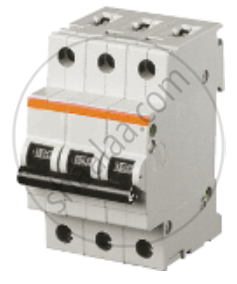
Identify the figure and give its use.
A coil of an alloy _______ is used in electric heater cooker as a resistor.
What is the heating effect of electric current?
What is a short circuit?
What is overloading?
What is used to turn off the sudden increase in current in the electrical circuit of the house nowadays?
Explain the application of heating effect of electric current in an electric bulb with a diagram.
Name some devices that run using heat effect of electric current
Explain the heating effect of electric current.
Mark the correct choice
- Assertion: Electric appliances with a metallic body have three wire connections.
- Reason: Three-pin connections reduce the heating of the connecting wires.
Which of the following gases are filled in electric bulbs?
An electric kettle consumes 1 kW of electric power when operated at 220 V. A fuse wire of what rating must be used for it?
Why is parallel arrangement used in domestic wiring?
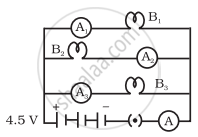
B1, B2 and B3 are three identical bulbs connected as shown in Figure. When all the three bulbs glow, a current of 3A is recorded by the ammeter A.
- What happens to the glow of the other two bulbs when the bulb B1 gets fused?
- What happens to the reading of A1, A2, A3 and A when the bulb B2 gets fused?
- How much power is dissipated in the circuit when all the three bulbs glow together?
What are the factors affecting heating effect of electric current?
Explain the working of an electric fuse.
It would cost a man Rs. 3.50 to buy 1.0 kW h of electrical energy from the Main Electricity Board. His generator has a maximum power of 2.0 kW. The generator produces energy at this maximum power for 3 hours. Calculate how much it would cost to buy the same amount of energy from the Main Electricity Board.
A trip switch is a ______ safety device.
A fuse is used in an electric circuit to stop high currents flowing through the circuit.
The electric fuse works on the Joule heating principle.
If 220 V potential difference is applied across an electric bulb, a current of 0.45 A flows in the bulb. What must be the power of the bulb?
Tara, after completing her exams, went to her grandmother's house along with her younger brother Rahul. One day, Rahul came home after playing and switched on the fan and air conditioner. At the same time, his grandmother was preparing a milkshake for him using a mixer. Suddenly, they heard a big sound and the electricity of the house got shut down. Tara is called an electrician. He said the main reason for supply to shut down was overloading.
- What is overloading?
- Is overloading and short the same? When does short-circuiting take place?
- How can the effects of overloading be avoided?
Find the odd one out.
1 kWh is equal to ______.
Two students decided to investigate the effect of water and air on iron object under identical experimental conditions. They measured the mass of each object before placing it partially immersed in 10 ml of water. After a few days, the object were removed, dried and their masses were measured. The table shows their results.
| Student | Object | Mass of Object before Rusting in g |
Mass of the coated object in g |
| A | Nail | 3.0 | 3.15 |
| B | Thin plate | 6.0 | 6.33 |
What might be the reason for the varied observations of the two students?
