Advertisements
Advertisements
प्रश्न
When does overloading occur?
Advertisements
उत्तर
Overloading occurs, when more appliances work together in a circuit.
APPEARS IN
संबंधित प्रश्न
How does the resistance of a wire vary with its area of cross-section?
An electric room heater draws a current of 2.4 A from the 120 V supply line. What current will this room heater draw when connected to 240 V supply line?
Give two reasons why nichrome alloy is used for making the heating elements of electrical appliances.
Write down the formula for the heat produced when a current I is passed through a resistor R for time t.
An electric iron of resistance 20 ohms draws a current of 5 amperes. Calculate the heat produced in 30 seconds.
The current passing through a room heater has been halved. What will happen to the heat produced by it?
What is meant by the heating effect of current?
Name the material which is used for making the filaments of an electric bulb.
An electric fuse works on the:
(a) chemical effect of current
(b) magnetic effect of current
(c) lighting effect of current
(d) heating effect of current
Give a scientific reason:
For electric power transmission, copper or aluminium wire is used.
Name any six domestic appliances based on the heating effect of electric current.
Which metal is used to make the filament of an electric bulb?
What is overloading?
Write two devices based on the heating effect of electric current.
Write scientific reason.
A coil made up of alloy Nichrome is used in the electric heater cooker as a resistor.
What does overloading cause?
True or False – If False give the correct answer
The fuse wire does not melts whenever there is overload in the wiring.
Name some devices that run using heat effect of electric current
Mark the correct choice
- Assertion: Electric appliances with a metallic body have three wire connections.
- Reason: Three-pin connections reduce the heating of the connecting wires.
An electric iron consumes energy at the rate of 420 W when heating is at the maximum rate and 180 W when heating is at the minimum rate. The applied voltage is 220 V. What is the current in each case?
An electric bulb is connected to a 220 V generator. The current is 0.50 A. What is the power of the bulb?
An electric kettle consumes 1 kW of electric power when operated at 220 V. A fuse wire of what rating must be used for it?
An electric component used as a safety device is electric circuit is ______.
Unscramble the following words:
SFEU
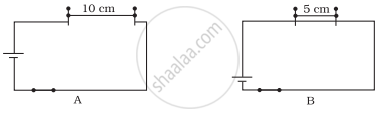
Paheli took a wire of length 10 cm. Boojho took a wire of 5 cm of the same material and thickness. Both of them connected the wires as shown in the circuit given in the following figure. The current flowing in both the circuits is the same.
- Will the heat produced in both cases be equal? Explain.
- Will the heat produced be the same if the wires taken by them are of equal lengths but of different thickness? Explain.
What are the uses of electromagnets?
What is an electric fuse made up of?
What are the factors affecting heating effect of electric current?
Copper wire offers very little ______ and does not get heated up quickly.
A student boils water in an electric kettle for 20 minutes. Using the same mains supply he wants to reduce the boiling time of water. To do so should he increase or decrease the length of the heating element? Justify your answer.
An electric fuse is a wire made up of a material having ______ melting point.
Find the odd one out.
Two students decided to investigate the effect of water and air on iron object under identical experimental conditions. They measured the mass of each object before placing it partially immersed in 10 ml of water. After a few days, the object were removed, dried and their masses were measured. The table shows their results.
| Student | Object | Mass of Object before Rusting in g |
Mass of the coated object in g |
| A | Nail | 3.0 | 3.15 |
| B | Thin plate | 6.0 | 6.33 |
What might be the reason for the varied observations of the two students?
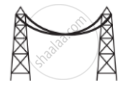
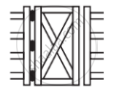
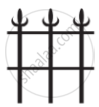
In which of the following applications of Iron, rusting will occur most? Support your answer with valid reason.
| A | B | C | D |
 |
 |
 |
 |
What is the heating effect of electric current?
When a current I flows through a wire of resistance R for time t then the electrical energy produced is given by ______.
An electric iron of resistance 20 Ω draws a current of 5 A. The heat developed in the iron in 30 seconds is ______.
An electric iron is rated 220 V, 2 kW. If the iron is used for 3h daily find the cost of running it for one week if it costs ₹ 4.25 per kWh.
