Advertisements
Advertisements
प्रश्न
The ‘live’ and the ‘neutral’ wires have potential difference of _______.
पर्याय
110 V
202 V
201 V
220 V
Advertisements
उत्तर
The ‘live’ and the ‘neutral’ wires have potential difference of 220 V.
APPEARS IN
संबंधित प्रश्न
The safety device based on the heating effect of electric current is called a ______.
Give two reasons why nichrome alloy is used for making the heating elements of electrical appliances.
An electric kettle rated at 220 V, 2.2 kW, works for 3 hours. Find the energy consumed and the current drawn.
What is meant by the heating effect of current?
Three heaters each rated 250 W, 100 V are connected in parallel to a 100 V supply. Calculate:
- the total current taken from the supply
- the resistance of each heater and
- the energy supplied in kWh to the three heaters in 5 hours.
Statement 1 : Electric current ( flow of electrons ) creates heat in the resistor.
Statement 2 : Heat in the resistor is created according to the rule of energy conservation.
Explain Statement 1 with the help of Statement 2.
Statement 1 : Electric current ( flow of electrons ) creates heat in the resistor.
Statement 2 : Heat in the resistor is created according to the rule of energy conservation.
Explain Statement 1 with the help of Statement 2.
Name any six domestic appliances based on the heating effect of electric current.
Compute the heat generated while transferring 96000 coulombs of charge in two hours through a potential difference of 40 V.
Which metal is used to make the filament of an electric bulb?
What is overloading?
Right or wrong sentence.
Live wire and neutral wires have a 220 V potential difference.
When does overloading occur?
True or False – If False give the correct answer
The fuse wire does not melts whenever there is overload in the wiring.
Explain the heating effect of electric current.
Which of the following is correct?
Mark the correct choice
- Assertion: Electric appliances with a metallic body have three wire connections.
- Reason: Three-pin connections reduce the heating of the connecting wires.
An electric bulb is connected to a 220 V generator. The current is 0.50 A. What is the power of the bulb?
An electric kettle consumes 1 kW of electric power when operated at 220 V. A fuse wire of what rating must be used for it?
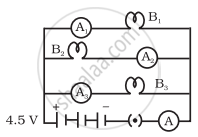
B1, B2 and B3 are three identical bulbs connected as shown in Figure. When all the three bulbs glow, a current of 3A is recorded by the ammeter A.
- What happens to the glow of the other two bulbs when the bulb B1 gets fused?
- What happens to the reading of A1, A2, A3 and A when the bulb B2 gets fused?
- How much power is dissipated in the circuit when all the three bulbs glow together?
Three incandescent bulbs of 100 W each are connected in series in an electric circuit. In another circuit another set of three bulbs of the same wattage are connected in parallel to the same source.
- Will the bulb in the two circuits glow with the same brightness? Justify your answer.
- Now let one bulb in both the circuits get fused. Will the rest of the bulbs continue to glow in each circuit? Give reason.
(a) Observe the diagram given below and state whether the bulb will glow or not when we switch on K.
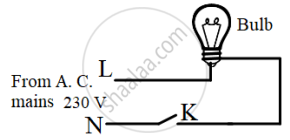
(b) Is it safe to handle the bulb when the switch is OFF?
(c) Give a reason for your answer in (b).
An electric component used as a safety device is electric circuit is ______.
An electric cell produces electricity from the ______ ______ in it.
Can we use the same fuse in a geyser and a television set? Explain.
Your teacher has shown you the following activity.
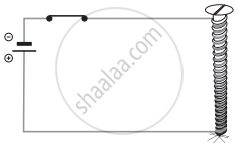
Activity: Teacher has wound a long insulated piece of wire around an iron nail in the form of a coil. Free ends of the wire are connected to a cell through a switch as shown in the following figure. The current is switched on and some pins are placed near the ends of the nail.
Write down any three questions that come to your mind about this activity.
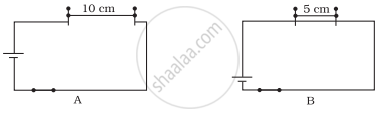
Paheli took a wire of length 10 cm. Boojho took a wire of 5 cm of the same material and thickness. Both of them connected the wires as shown in the circuit given in the following figure. The current flowing in both the circuits is the same.
- Will the heat produced in both cases be equal? Explain.
- Will the heat produced be the same if the wires taken by them are of equal lengths but of different thickness? Explain.
______ wire is used in the filament of the bulbs.
A student boils water in an electric kettle for 20 minutes. Using the same mains supply he wants to reduce the boiling time of water. To do so should he increase or decrease the length of the heating element? Justify your answer.
An electrochemical cell converts ______ energy into ______ energy.
Find the odd one out.
1 kWh is equal to ______.
An electric kettle of 2 kW is used for 2h. Calculate the energy consumed in
- kilowatt hour and
- joules.
An electric iron of resistance 20 Ω draws a current of 5 A. The heat developed in the iron in 30 seconds is ______.
The graph of voltage vs current for four different materials is shown below.

Which of these four materials would be used for making filament of bulb?
An electric iron is rated 220 V, 2 kW. If the iron is used for 3h daily find the cost of running it for one week if it costs ₹ 4.25 per kWh.
