Advertisements
Advertisements
प्रश्न
An electric kettle of 2 kW is used for 2h. Calculate the energy consumed in
- kilowatt hour and
- joules.
Advertisements
उत्तर
(i) Power, P = `"E"/"t"`
So, energy consumed, E = P × t = 2 × 2 = 4 kWh
(ii) Energy consumed, E = 4 kWh
= 4 × 1000 × 3600 J
= 1.44 × 10⁷ J
APPEARS IN
संबंधित प्रश्न
Why are the conductors of electric heating devices, such as bread-toasters and electric irons, made of an alloy rather than a pure metal?
How does the resistance of a wire vary with its area of cross-section?
Which of the following characteristic is not suitable for a fuse wire?
(a) thin and short
(b) thick and short
(c) low melting point
(d) higher resistance than rest of wiring
The electrical resistivities of four materials P, Q, R and S are given below:
| P | `6.84xx10^8`Ωm |
| Q | `1.70xx10^8`Ωm |
| R | ` 1.0xx10^15`Ωm |
| s | `11.0xx10^-7`Ωm |
Which material will you use for making: (a) heating element of electric iron (b) connecting wires of electric iron (c) covering of connecting wires? Give reason for your choice in each case.
Why does tungsten metal used to make solenoid type coil in an electric bulb?
How can overloading be avoided?
How does use of a fuse wire protect electrical appliances?
Your teacher has shown you the following activity.
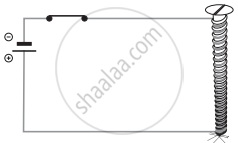
Activity: Teacher has wound a long insulated piece of wire around an iron nail in the form of a coil. Free ends of the wire are connected to a cell through a switch as shown in the following figure. The current is switched on and some pins are placed near the ends of the nail.
Write down any three questions that come to your mind about this activity.
An electric fuse has a body made of ceramic and two points for connecting the fuse wire.
An electrochemical cell converts ______ energy into ______ energy.
