Advertisements
Advertisements
Question
An electric kettle of 2 kW is used for 2h. Calculate the energy consumed in
- kilowatt hour and
- joules.
Advertisements
Solution
(i) Power, P = `"E"/"t"`
So, energy consumed, E = P × t = 2 × 2 = 4 kWh
(ii) Energy consumed, E = 4 kWh
= 4 × 1000 × 3600 J
= 1.44 × 10⁷ J
APPEARS IN
RELATED QUESTIONS
Why does the cord of an electric heater not glow while the heating element does?
An electric kettle rated at 220 V, 2.2 kW, works for 3 hours. Find the energy consumed and the current drawn.
Statement 1 : Electric current ( flow of electrons ) creates heat in the resistor.
Statement 2 : Heat in the resistor is created according to the rule of energy conservation.
Explain Statement 1 with the help of Statement 2.
Name any six domestic appliances based on the heating effect of electric current.
Answer the following question:
what is the heating effect of the electric current? state any four applications of it?
Explain the application of heating effect of electric current in an electric bulb with a diagram.
Name any two appliances which work under the principle of heating effect of current.
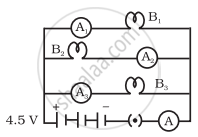
B1, B2 and B3 are three identical bulbs connected as shown in Figure. When all the three bulbs glow, a current of 3A is recorded by the ammeter A.
- What happens to the glow of the other two bulbs when the bulb B1 gets fused?
- What happens to the reading of A1, A2, A3 and A when the bulb B2 gets fused?
- How much power is dissipated in the circuit when all the three bulbs glow together?
Your teacher has shown you the following activity.
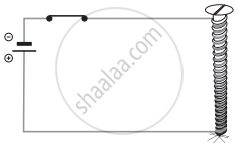
Activity: Teacher has wound a long insulated piece of wire around an iron nail in the form of a coil. Free ends of the wire are connected to a cell through a switch as shown in the following figure. The current is switched on and some pins are placed near the ends of the nail.
Write down any three questions that come to your mind about this activity.
A student boils water in an electric kettle for 20 minutes. Using the same mains supply he wants to reduce the boiling time of water. To do so should he increase or decrease the length of the heating element? Justify your answer.
