Advertisements
Advertisements
प्रश्न
Statement 1 : Electric current ( flow of electrons ) creates heat in the resistor.
Statement 2 : Heat in the resistor is created according to the rule of energy conservation.
Explain Statement 1 with the help of Statement 2.
Advertisements
उत्तर
i. When electrons flows through the resistor (during flowing electric current) electron possesses kinetic energy.
ii. During the flow of electron there is decrease in kinetic energy of electrons due to collision on atoms, ions and molecules.
iii. According to the law of conservation of energy decrease in kinetic energy gets converted into heat.
APPEARS IN
संबंधित प्रश्न
Write Joule's law of heating.
An electric iron of resistance 20 ohms draws a current of 5 amperes. Calculate the heat produced in 30 seconds.
The current passing through an electric kettle has been doubled. The heat produced will become:
(a) half
(b) double
(c) four time
(d) one-fourth
An electric fuse works on the:
(a) chemical effect of current
(b) magnetic effect of current
(c) lighting effect of current
(d) heating effect of current
The elements of electrical heating devices are usually made of:
(a) tungsten
(b) bronze
(c) nichrome
(d) argon
Which of the following characteristic is not suitable for a fuse wire?
(a) thin and short
(b) thick and short
(c) low melting point
(d) higher resistance than rest of wiring
If the current flowing through a fixed resistor is halved, the heat produced in it will become:
The electrical resistivities of four materials P, Q, R and S are given below:
| P | `6.84xx10^8`Ωm |
| Q | `1.70xx10^8`Ωm |
| R | ` 1.0xx10^15`Ωm |
| s | `11.0xx10^-7`Ωm |
Which material will you use for making: (a) heating element of electric iron (b) connecting wires of electric iron (c) covering of connecting wires? Give reason for your choice in each case.
Give a scientific reason.
Tungsten metal is used to make a solenoid type coil in an electric bulb.
Why does tungsten metal used to make solenoid type coil in an electric bulb?
Give scientific reason :
In the electric equipment producing heat e.g. iron, electric heater, boiler, toaster, etc., an alloy such as Nichrome is used, not pure metals.
Name the factors on which the heat produced in a wire depends when current is passed in it, and state how does it depend on the factors stated by you.
The ‘live’ and the ‘neutral’ wires have potential difference of _______.
In an electric bulb, coil of _______ metal is used.
These days when current in the circuit suddenly increases _______ switches are used.
Which of the following substance contracts on heating?
What is the heating effect of electric current?
Write scientific reason.
A coil made up of alloy Nichrome is used in the electric heater cooker as a resistor.
When does overloading occur?
What does overloading cause?
Name some devices that run using heat effect of electric current
Name any two appliances which work under the principle of heating effect of current.
Which of the following is correct?
The heating element of an electric iron is made up of:
How does use of a fuse wire protect electrical appliances?
Why is parallel arrangement used in domestic wiring?
(a) Observe the diagram given below and state whether the bulb will glow or not when we switch on K.
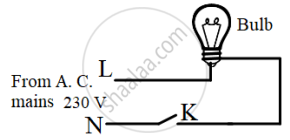
(b) Is it safe to handle the bulb when the switch is OFF?
(c) Give a reason for your answer in (b).
Can we use the same fuse in a geyser and a television set? Explain.
An MCB can be used instead of a fuse in an electrical circuit.
What are the uses of electromagnets?
What is an electric fuse made up of?
______ wire is used in the filament of the bulbs.
Copper wire offers very little ______ and does not get heated up quickly.
What is a trip switch?
Explain why fuse wire is always connected in a series arrangement.
Find the odd one out.
An electric kettle of 2 kW is used for 2h. Calculate the energy consumed in
- kilowatt hour and
- joules.
Write an expression for the amount of heat produced in a resistor when an electric current is passed through it stating the meanings of the symbols used.
