Advertisements
Advertisements
Questions
Write two devices based on the heating effect of electric current.
Name any three appliances based on the heating effect of electric current.
Advertisements
Solution
Fuse wire, electric iron, electric bulb, electric cooker, geyser.
APPEARS IN
RELATED QUESTIONS
State four most common electrical appliances based on heating effect of electric current. Why do we use finely heated platinum wire in surgery?
Why is the tungsten used almost exclusively for filament of electric lamps?
Why are the conductors of electric heating devices, such as bread-toasters and electric irons, made of an alloy rather than a pure metal?
How does the resistance of a wire vary with its area of cross-section?
Give two reasons why nichrome alloy is used for making the heating elements of electrical appliances.
Why are the coils of electric irons and electric toasters made of an alloy rather than a pure metal?
Write down the formula for the heat produced when a current I is passed through a resistor R for time t.
Explain why, the current that makes the heater element very hot, only slightly warms the connecting wires leading to the heater.
An electric fuse works on the:
(a) chemical effect of current
(b) magnetic effect of current
(c) lighting effect of current
(d) heating effect of current
The elements of electrical heating devices are usually made of:
(a) tungsten
(b) bronze
(c) nichrome
(d) argon
The heat produced in a wire of resistance 'x' when a current 'y' flows through it in time 'z' is given by:
(a) x2 × y × z
(b) x × z × y2
(c) y × z2 × x
(d) y × z × x
Which of the following characteristic is not suitable for a fuse wire?
(a) thin and short
(b) thick and short
(c) low melting point
(d) higher resistance than rest of wiring
How does the wire in the filament of a light bulb behave differently to the other wires in the circuit when the current flows?
What property of the filament wire accounts for this difference?
Two exactly similar heating resistances are connected (i) in series, and (ii) in parallel, in two different circuits, one by one. If the same current is passed through both the combinations, is more heat obtained per minute when they are connected in series or when they are connected in parallel? Give reason for your answer.
An electric iron is connected to the mains power supply of 220 V. When the electric iron is adjusted at ‘minimum heating' it consumes a power of 360 W but at 'maximum heating’ it takes a power of 840 W. Calculate the current and resistance in each case.
Statement 1 : Electric current ( flow of electrons ) creates heat in the resistor.
Statement 2 : Heat in the resistor is created according to the rule of energy conservation.
Explain Statement 1 with the help of Statement 2.
Statement 1 : Electric current ( flow of electrons ) creates heat in the resistor.
Statement 2 : Heat in the resistor is created according to the rule of energy conservation.
Explain Statement 1 with the help of Statement 2.
Why does tungsten metal used to make solenoid type coil in an electric bulb?
Write the mathematical expression for Joule’s law of heating.
These days when current in the circuit suddenly increases _______ switches are used.
What is overloading?
Write scientific reason.
A coil made up of alloy Nichrome is used in the electric heater cooker as a resistor.
Explain the application of heating effect of electric current in an electric bulb with a diagram.
True or False – If False give the correct answer
The fuse wire does not melts whenever there is overload in the wiring.
Name some devices that run using heat effect of electric current
Which of the following is correct?
An electric iron consumes energy at the rate of 420 W when heating is at the maximum rate and 180 W when heating is at the minimum rate. The applied voltage is 220 V. What is the current in each case?
An electric iron draws a current of 4 A when connected to 220 V mains. Its resistance must be:
A fuse wire repeatedly gets burnt when used with a good heater. It is advised to use a fuse wire of:
A current of 1 A is drawn by a filament of an electric bulb. Number of electrons passing through a cross-section of the filament in 16 seconds would be roughly:
Your teacher has shown you the following activity.
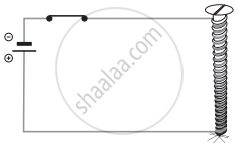
Activity: Teacher has wound a long insulated piece of wire around an iron nail in the form of a coil. Free ends of the wire are connected to a cell through a switch as shown in the following figure. The current is switched on and some pins are placed near the ends of the nail.
Write down any three questions that come to your mind about this activity.
An electric fuse has a body made of ceramic and two points for connecting the fuse wire.
What is an electric fuse made up of?
Copper wire offers very little ______ and does not get heated up quickly.
Fuse is a strip of alloy wire which is made up of lead and tin with a very low ______.
Name a few appliances which work on the basis of the heating effect of current.
What is a trip switch?
An electric fuse is a wire made up of a material having ______ melting point.
The electric fuse works on the Joule heating principle.
Define the following:
Electrolyte
1 kWh is equal to ______.
What is the heating effect of electric current?
Write an expression for the amount of heat produced in a resistor when an electric current is passed through it stating the meanings of the symbols used.
