Advertisements
Advertisements
Question
Explain the importance/uses of fuse wire.
Advertisements
Solution
- Fuse is an important application of heating effect of electric current used in electric circuits.
- It protects circuits and appliances by stopping the flow of any excess electric current.
- If a current larger than the specific value flows through the circuit, the temperature of fuse wire increases. This melts the fuse wire and breaks the circuit.
- In summer season, when consumption of electrical power is huge in the evening due to home lighting, fan, air conditioner, use of electricity in shops etc, an excessive current is drawn from the transformer. If the capacity of the transformer is insufficient, its fuse wire melts, and the supply gets shut down.
RELATED QUESTIONS
The safety device based on the heating effect of electric current is called a ______.
Why does the connecting cord of an electric heater not glow hot while the heating element does?
An electric iron of resistance 20 ohms draws a current of 5 amperes. Calculate the heat produced in 30 seconds.
Explain why, the current that makes the heater element very hot, only slightly warms the connecting wires leading to the heater.
The elements of electrical heating devices are usually made of:
(a) tungsten
(b) bronze
(c) nichrome
(d) argon
The heat produced in a wire of resistance 'x' when a current 'y' flows through it in time 'z' is given by:
(a) x2 × y × z
(b) x × z × y2
(c) y × z2 × x
(d) y × z × x
The electrical resistivities of four materials P, Q, R and S are given below:
| P | `6.84xx10^8`Ωm |
| Q | `1.70xx10^8`Ωm |
| R | ` 1.0xx10^15`Ωm |
| s | `11.0xx10^-7`Ωm |
Which material will you use for making: (a) heating element of electric iron (b) connecting wires of electric iron (c) covering of connecting wires? Give reason for your choice in each case.
An electric iron is connected to the mains power supply of 220 V. When the electric iron is adjusted at ‘minimum heating' it consumes a power of 360 W but at 'maximum heating’ it takes a power of 840 W. Calculate the current and resistance in each case.
Three heaters each rated 250 W, 100 V are connected in parallel to a 100 V supply. Calculate:
- the total current taken from the supply
- the resistance of each heater and
- the energy supplied in kWh to the three heaters in 5 hours.
Give a scientific reason:
For electric power transmission, copper or aluminium wire is used.
Name the factors on which the heat produced in a wire depends when current is passed in it, and state how does it depend on the factors stated by you.
Name any six domestic appliances based on the heating effect of electric current.
Answer the following question:
what is the heating effect of the electric current? state any four applications of it?
Find the odd one out and give its explanation.
What is the heating effect of electric current?
What is overloading?
How can overloading be avoided?
Name some devices that run using heat effect of electric current
Name any two appliances which work under the principle of heating effect of current.
An electric iron draws a current of 4 A when connected to 220 V mains. Its resistance must be:
A current of 1 A is drawn by a filament of an electric bulb. Number of electrons passing through a cross-section of the filament in 16 seconds would be roughly:
Assertion: Bending of wire decreases the resistance of the electric wire.
Reason: The resistance of a conductor depends on length, thickness, nature of material and temperature of the conductor.
What is Joule’s heating effect? How can it be demonstrated experimentally? List its four applications in daily life.
When a switch is in OFF position,
- circuit starting from the positive terminal of the cell stops at the switch.
- circuit is open.
- no current flows through it.
- current flows after some time.
Choose the combination of correct answer from the following.
An electric cell produces electricity from the ______ ______ in it.
Unscramble the following words:
SFEU
An MCB can be used instead of a fuse in an electrical circuit.
An electric fuse has a body made of ceramic and two points for connecting the fuse wire.
What are the factors affecting heating effect of electric current?
Fuse is a strip of alloy wire which is made up of lead and tin with a very low ______.
Match the following
| 1. | Bulb | a. | Conductor |
| 2. | Electroplating | b. |
Insulator |
| 3. | Pure water | c. | Heating effect of current |
| 4. | Salt solution | d. | Chemical effect of current |
Name the effect of the current responsible for the glow of the bulb in an electrical circuit.
An electrochemical cell converts ______ energy into ______ energy.
The electric fuse works on the Joule heating principle.
1 kWh is equal to ______.
Two students decided to investigate the effect of water and air on iron object under identical experimental conditions. They measured the mass of each object before placing it partially immersed in 10 ml of water. After a few days, the object were removed, dried and their masses were measured. The table shows their results.
| Student | Object | Mass of Object before Rusting in g |
Mass of the coated object in g |
| A | Nail | 3.0 | 3.15 |
| B | Thin plate | 6.0 | 6.33 |
What might be the reason for the varied observations of the two students?
In which of the following applications of Iron, rusting will occur most? Support your answer with valid reason.
| A | B | C | D |
 |
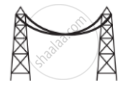 |
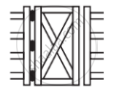 |
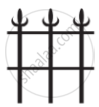 |
In a set up the students coated iron nails with zinc metal and noted that, iron nails coated with zinc prevents rusting. They also observed that zinc initially acts as a physical barrier, but an extra advantage of using zinc is that it continues to prevent rusting even if the layer of zinc is damaged. Name this process of rust prevention and give any two other methods to prevent rusting.
What is the heating effect of electric current?
