Advertisements
Advertisements
Question
Name any six domestic appliances based on the heating effect of electric current.
Advertisements
Solution
APPEARS IN
RELATED QUESTIONS
Name any two effects of electric current.
Write Joule's law of heating.
An electric room heater draws a current of 2.4 A from the 120 V supply line. What current will this room heater draw when connected to 240 V supply line?
What is nichrome? State its one use.
Why is a series arrangement not used for connecting domestic electrical appliances in a circuit?
Explain why, the current that makes the heater element very hot, only slightly warms the connecting wires leading to the heater.
A resistance of 25 Ω is connected to a 12 V battery. Calculate the heat energy in joules generated per minute.
How much heat will an instrument of 12 W produce in one minute if it is connected to the heat produced by it?
Name the material which is used for making the filaments of an electric bulb.
If the current flowing through a fixed resistor is halved, the heat produced in it will become:
Give a scientific reason.
Tungsten metal is used to make a solenoid type coil in an electric bulb.
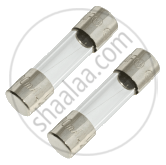
Identify the figure and give its use.
An electric iron of 1100 W is operated for 2 hrs daily. What will be the electrical consumption expenses for that in the month of April? (The electric company charges Rs 5 per unit of energy).
Rewrite the following statement by selecting the correct option:
1 A = ____________ mA.
In an electric bulb, coil of _______ metal is used.
Which of the following substance contracts on heating?
Write scientific reason.
A coil made up of alloy Nichrome is used in the electric heater cooker as a resistor.
When does overloading occur?
Name some devices that run using heat effect of electric current
Heating effect of current is called ______
Which of the following is correct?
The heating element of an electric iron is made up of:
An electric bulb is connected to a 220 V generator. The current is 0.50 A. What is the power of the bulb?
How does use of a fuse wire protect electrical appliances?
An electric cell produces electricity from the ______ ______ in it.
Your teacher has shown you the following activity.
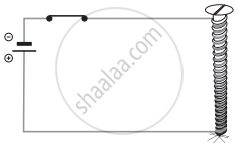
Activity: Teacher has wound a long insulated piece of wire around an iron nail in the form of a coil. Free ends of the wire are connected to a cell through a switch as shown in the following figure. The current is switched on and some pins are placed near the ends of the nail.
Write down any three questions that come to your mind about this activity.
What are the uses of electromagnets?
What is an electric fuse made up of?
If 220 V potential difference is applied across an electric bulb, a current of 0.45 A flows in the bulb. What must be the power of the bulb?
Find the odd one out.
An electric kettle of 2 kW is used for 2h. Calculate the energy consumed in
- kilowatt hour and
- joules.
An electric iron of resistance 20 Ω draws a current of 5 A. The heat developed in the iron in 30 seconds is ______.
