Advertisements
Advertisements
Question
In an electric bulb, coil of _______ metal is used.
Options
copper
tungsten
aluminium
iron
Advertisements
Solution
In an electric bulb, coil of tungsten metal is used.
APPEARS IN
RELATED QUESTIONS
State four most common electrical appliances based on heating effect of electric current. Why do we use finely heated platinum wire in surgery?
Compute the heat generated while transferring 96000 coulomb of charge in one hour through a potential difference of 50 V.
An electric iron of resistance 20 Ω takes a current of 5 A. Calculate the heat developed in 30 s.
Why is the tungsten used almost exclusively for filament of electric lamps?
Name any two effects of electric current.
When current is switched ‘on’ in a room heater, it ______.
Give two reasons why nichrome alloy is used for making the heating elements of electrical appliances.
How does the resistance of a wire vary with its:
diameter?
An electric kettle rated at 220 V, 2.2 kW, works for 3 hours. Find the energy consumed and the current drawn.
An electric iron of resistance 20 ohms draws a current of 5 amperes. Calculate the heat produced in 30 seconds.
Explain why, tungsten is used for making the filaments of electric bulbs.
The current passing through a room heater has been halved. What will happen to the heat produced by it?
Name the material which is used for making the filaments of an electric bulb.
Two exactly similar heating resistances are connected (i) in series, and (ii) in parallel, in two different circuits, one by one. If the same current is passed through both the combinations, is more heat obtained per minute when they are connected in series or when they are connected in parallel? Give reason for your answer.
An electric iron is connected to the mains power supply of 220 V. When the electric iron is adjusted at ‘minimum heating' it consumes a power of 360 W but at 'maximum heating’ it takes a power of 840 W. Calculate the current and resistance in each case.
Give a scientific reason.
Tungsten metal is used to make a solenoid type coil in an electric bulb.
Solve the following example.
Two tungsten bulbs of wattage 100 W and 60 W power work on 220 V potential difference. If they are connected in parallel, how much current will flow in the main conductor?
An electric iron of 1100 W is operated for 2 hrs daily. What will be the electrical consumption expenses for that in the month of April? (The electric company charges Rs 5 per unit of energy).
Compute the heat generated while transferring 96000 coulombs of charge in two hours through a potential difference of 40 V.
A coil of an alloy _______ is used in electric heater cooker as a resistor.
What is the heating effect of electric current?
Which metal is used to make the filament of an electric bulb?
Name any two appliances which works on the phenomenon of heating effect of electric current.
Three incandescent bulbs of 100 W each are connected in series in an electric circuit. In another circuit another set of three bulbs of the same wattage are connected in parallel to the same source.
- Will the bulb in the two circuits glow with the same brightness? Justify your answer.
- Now let one bulb in both the circuits get fused. Will the rest of the bulbs continue to glow in each circuit? Give reason.
(a) Observe the diagram given below and state whether the bulb will glow or not when we switch on K.
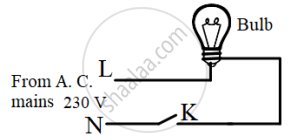
(b) Is it safe to handle the bulb when the switch is OFF?
(c) Give a reason for your answer in (b).
An electric cell produces electricity from the ______ ______ in it.
Name two electric devices for each where
- heating effect of current is used and
- magnetic effect of current is used.
Your teacher has shown you the following activity.
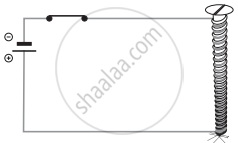
Activity: Teacher has wound a long insulated piece of wire around an iron nail in the form of a coil. Free ends of the wire are connected to a cell through a switch as shown in the following figure. The current is switched on and some pins are placed near the ends of the nail.
Write down any three questions that come to your mind about this activity.
Fuse is a strip of alloy wire which is made up of lead and tin with a very low ______.
Assertion: A current-carrying wire should be charged.
Reason: The current in a wire is due to the flow of free electrons in a definite direction.
The following is not a safety device.
The electric fuse works on the Joule heating principle.
Find the odd one out.
When a current I flows through a wire of resistance R for time t then the electrical energy produced is given by ______.
An electric iron of resistance 20 Ω draws a current of 5 A. The heat developed in the iron in 30 seconds is ______.
