Advertisements
Advertisements
Question
Right or wrong sentence.
Live wire and neutral wires have a 220 V potential difference.
Options
Right
Wrong
Advertisements
Solution
The given sentence is right.
Explanation:
In standard domestic electrical circuits, the live wire carries the current at a high potential of 220 V, while the neutral wire completes the circuit and is maintained at zero potential (0 V). Because of this, the resulting potential difference or voltage between the two wires is exactly 220 V.
RELATED QUESTIONS
Why does the cord of an electric heater not glow while the heating element does?
An electric iron of resistance 20 Ω takes a current of 5 A. Calculate the heat developed in 30 s.
An electric heater of resistance 8 Ω draws 15 A from the service mains 2 hours. Calculate the rate at which heat is developed in the heater.
Why is the tungsten used almost exclusively for filament of electric lamps?
When current is switched ‘on’ in a room heater, it ______.
Why are the coils of electric irons and electric toasters made of an alloy rather than a pure metal?
How much heat will an instrument of 12 W produce in one minute if it is connected to the heat produced by it?
An electric iron is connected to the mains power supply of 220 V. When the electric iron is adjusted at ‘minimum heating' it consumes a power of 360 W but at 'maximum heating’ it takes a power of 840 W. Calculate the current and resistance in each case.
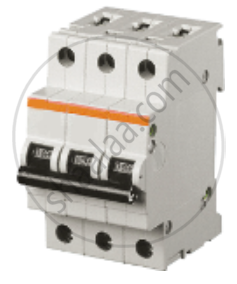
Identify the figure and give its use.
Heat energy is being produced in a resistance in a circuit at the rate of 100 W. The current of 3 A is flowing in the circuit. What must be the value of the resistance?
Statement 1 : Electric current ( flow of electrons ) creates heat in the resistor.
Statement 2 : Heat in the resistor is created according to the rule of energy conservation.
Explain Statement 1 with the help of Statement 2.
Give scientific reason :
In the electric equipment producing heat e.g. iron, electric heater, boiler, toaster, etc., an alloy such as Nichrome is used, not pure metals.
The ‘live’ and the ‘neutral’ wires have potential difference of _______.
In an electric bulb, coil of _______ metal is used.
A coil of an alloy _______ is used in electric heater cooker as a resistor.
A fuse wire repeatedly gets burnt when used with a good heater. It is advised to use a fuse wire of:
Assertion: Bending of wire decreases the resistance of the electric wire.
Reason: The resistance of a conductor depends on length, thickness, nature of material and temperature of the conductor.
An electric kettle consumes 1 kW of electric power when operated at 220 V. A fuse wire of what rating must be used for it?
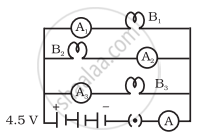
B1, B2 and B3 are three identical bulbs connected as shown in Figure. When all the three bulbs glow, a current of 3A is recorded by the ammeter A.
- What happens to the glow of the other two bulbs when the bulb B1 gets fused?
- What happens to the reading of A1, A2, A3 and A when the bulb B2 gets fused?
- How much power is dissipated in the circuit when all the three bulbs glow together?
What is Joule’s heating effect? How can it be demonstrated experimentally? List its four applications in daily life.
An electric cell produces electricity from the ______ ______ in it.
Name two electric devices for each where
- heating effect of current is used and
- magnetic effect of current is used.
Your teacher has shown you the following activity.
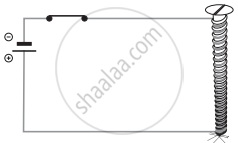
Activity: Teacher has wound a long insulated piece of wire around an iron nail in the form of a coil. Free ends of the wire are connected to a cell through a switch as shown in the following figure. The current is switched on and some pins are placed near the ends of the nail.
Write down any three questions that come to your mind about this activity.
An electric fuse has a body made of ceramic and two points for connecting the fuse wire.
Match the following
| 1. | Bulb | a. | Conductor |
| 2. | Electroplating | b. |
Insulator |
| 3. | Pure water | c. | Heating effect of current |
| 4. | Salt solution | d. | Chemical effect of current |
A student boils water in an electric kettle for 20 minutes. Using the same mains supply he wants to reduce the boiling time of water. To do so should he increase or decrease the length of the heating element? Justify your answer.
What is a trip switch?
An electrochemical cell converts ______ energy into ______ energy.
Define the following:
Electrolyte
Find the odd one out.
Two students decided to investigate the effect of water and air on iron object under identical experimental conditions. They measured the mass of each object before placing it partially immersed in 10 ml of water. After a few days, the object were removed, dried and their masses were measured. The table shows their results.
| Student | Object | Mass of Object before Rusting in g |
Mass of the coated object in g |
| A | Nail | 3.0 | 3.15 |
| B | Thin plate | 6.0 | 6.33 |
What might be the reason for the varied observations of the two students?
In a set up the students coated iron nails with zinc metal and noted that, iron nails coated with zinc prevents rusting. They also observed that zinc initially acts as a physical barrier, but an extra advantage of using zinc is that it continues to prevent rusting even if the layer of zinc is damaged. Name this process of rust prevention and give any two other methods to prevent rusting.
What is the heating effect of electric current?
Write an expression for the amount of heat produced in a resistor when an electric current is passed through it stating the meanings of the symbols used.
An electric iron of resistance 20 Ω draws a current of 5 A. The heat developed in the iron in 30 seconds is ______.
The graph of voltage vs current for four different materials is shown below.

Which of these four materials would be used for making filament of bulb?
