Advertisements
Advertisements
Question
Resistances R1, R2, R3 and R4 are connected as shown in the figure. S1 and S2 are two keys. Discuss the current flowing in the circuit in the following cases.
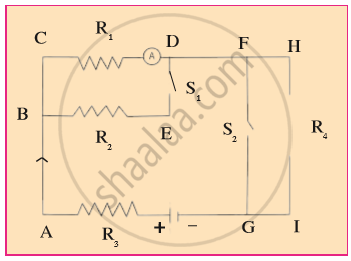
- Both S1 and S2 are closed.
- Both S1 and S2 are open.
- S1 is closed but S2 is open.
Advertisements
Solution
a.
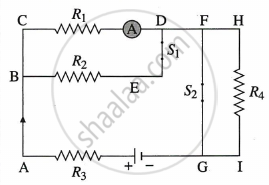
Due to the zero resistance of FG in a parallel series combination of R4, the resultant resistance of this combination will also be almost zero, and the entire electric current will flow through the path.
Resultant resistance of parallel series combination of R1, R2
∴ `I_3 = V/(R_3 + R_S)`
`V_1 = V - I_3 R_3`
= `V - (R_3 V)/(R_3 + R_p)`
= `V (1 - R_3/(R_3 + R_p))`
= `V (R_p/(R_3 + R_p))`
∴ `I_1 = V_1/R_1 = V/R_1(R_p/(R_3 + R_p))`
similarly,
`I_2 = V/R_2(R_p/(R_3 + R_p))`
b.
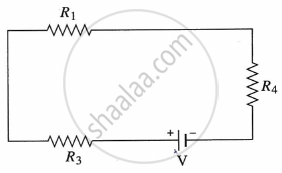
Equivalent resistance of series combination of R1, R3, R4
`R_S = R_1 + R_3 + R_4`
Current in the circuit,
`I = V/(R_1 + R_3 + R_4)`
c.
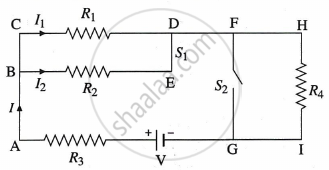
`R_P = (R_1 R_2)/(R_1 + R_2)`
`R_S = R_3 + R_4 + (R_1 R_2)/(R_1 + R_2)`
`I = V/R_S = I_3 = I_4`
Also, `I = I_1 + I_2` and `R_1 I_1 = R_2 I_2`
∴ `I = I_1 + (I_1 R_1)/R_2`
∴ `I_1(1 + R_1/R_2)`
= `(I_1(R_1 + R_2))/R_2`
`I_1 = (R_2 I)/(R_1 + R_2)`
and `I_2 = (I_1 R_1)/R_2`
= `R_1/R_2((R_1 I)/(R_1 + R_2))`
= `(R_1 I)/(R_1 + R_2)`
APPEARS IN
RELATED QUESTIONS
Draw circuit symbols for variable resistance
Draw circuit symbols for
a cell
Draw circuit symbols for
an open switch
Who will spend more electrical energy? 500 W TV Set in 30 mins, or 600 W heater in 20 mins?
The following figure shows the symbols for components used in the accompanying electrical circuit. Place them at proper places and complete the circuit.
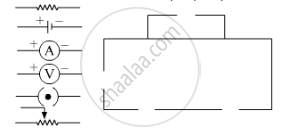
Which law can you prove with the help of above circuit?
A battery is to be formed by joining 3 dry cells with connecting wires. Show how will you connect the wires by drawing a diagram.
Answer the following question.
With the help of a suitable circuit diagram prove that the reciprocal of the equivalent resistance of a group of resistances joined in parallel is equal to the sum of the reciprocals of the individual resistances.
Draw a neat diagram showing a closed electric circuit.
Draw a neat diagram showing a open electric circuit.
Name the instrument used to control current in an electric circuit.
What is open circuit?
In the given circuit diagram, which of the given switch(s) should be closed. So that only bulb A glows.
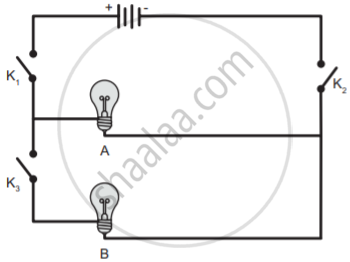
State whether true or false. If false, correct the statement.
Ammeter is connected in parallel in any electric circuit.
The wiring in a house consists of ______ circuits.
In a circuit, if the key is in open (off) condition, then electricity will not flow.
In an electrical circuit two resistors of 2 Ω and 4 Ω respectively are connected in series to a 6 V battery. The heat dissipated by the 4 Ω resistor in 5 s will be
Three bulbs A, B, C are connected in a circuit as shown in the following figure. When the switch is ‘ON’
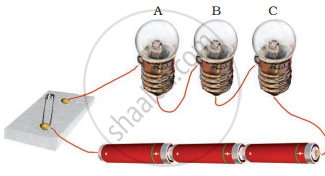
Observe the circuit given:
1. Would any of the bulbs glow when the switch is in the ‘OFF’ position?
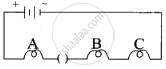
2. What will be the order in which the bulbs A, B, and C will glow when the switch is moved to the ‘ON’ position?
Overloading of electric circuits can lead to short-circuiting.
How is Joule's law effect useful in electric circuits where fuse is used as a safety device?
