Advertisements
Advertisements
Question
Explain about domestic electric circuits. (circuit diagram not required)
Advertisements
Solution
In our homes, electricity is distributed through the domestic electric circuits wired by the electricians. The first stage of the domestic circuit is to bring the power supply to the main box from a distribution panel, such as a transformer. The important components of the main box are: (i) a fuse box and (ii) a meter. The meter is used to record the consumption of electrical energy. The fuse box contains either a fuse wire or a Miniature Circuit Breaker (MCB). The function of the fuse wire or an MCB is to protect the household electrical appliances from overloading due to excess current.
An MCB is a switching device, which can be activated automatically as well as manually. It has a spring attached to the switch, which is attracted by an electromagnet when an excess current passes through the circuit. Hence, the circuit is broken and the protection of the appliance is ensured.
The electricity is brought to houses by one wire that has red insulation and is called the ‘live wire’. The other wire has black insulation and is called the ‘neutral wire’. The electricity supplied to your house is actually an alternating current having an electric potential of 220 V. Both, the live wire and the neutral wire enter into a box where the main fuse is connected with the live wire. After the electricity meter, these wires enter into the main switch, which is used to discontinue the electricity supply whenever required. After the main switch, these wires are connected to live wires of two separate circuits.
Out of these two circuits, one circuit is of a 5 A rating, which is used to run the electric appliances with a lower power rating, such as tube lights, bulbs, and fans. The other circuit is of a 15 A rating, which is used for two insulated wires. Out of these two wires, run electric appliances with a high power rating, such as air-conditioners, refrigerators, electric iron, and heaters. It should be noted that all the circuits in a house are connected in parallel so that the disconnection of one circuit does not affect the other circuit. One more advantage of the parallel connection of circuits is that each electric appliance gets an equal voltage.
APPEARS IN
RELATED QUESTIONS
Explain the construction and working of the following. Draw a neat diagram and label it.
Electric motor
Observe the following figure which bulb get fuse?

Draw a neat diagram showing a open electric circuit.
What is open circuit?
Find the odd one out and give its explanation.
______ is the device used to close or open an electric circuit.
When a circuit is open, _____ cannot pass through it.
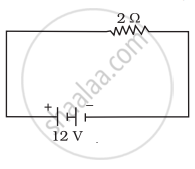
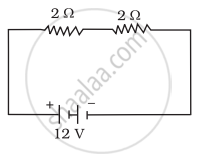
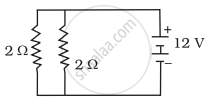
In the following circuits (Figure), heat produced in the resistor or combination of resistors connected to a 12 V battery will be
 |
 |
 |
| (i) | (ii) | (iii) |
In an electric circuit a fuse is a ______ ______ to prevent possible fire.
Name the device which is used to measure the strength of the electric current in an electric circuit.
