Advertisements
Advertisements
प्रश्न
Resistances R1, R2, R3 and R4 are connected as shown in the figure. S1 and S2 are two keys. Discuss the current flowing in the circuit in the following cases.
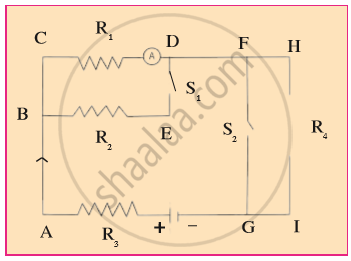
- Both S1 and S2 are closed.
- Both S1 and S2 are open.
- S1 is closed but S2 is open.
Advertisements
उत्तर
a.
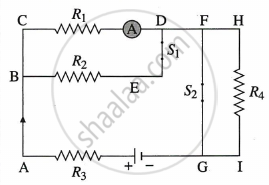
Due to the zero resistance of FG in a parallel series combination of R4, the resultant resistance of this combination will also be almost zero, and the entire electric current will flow through the path.
Resultant resistance of parallel series combination of R1, R2
∴ `I_3 = V/(R_3 + R_S)`
`V_1 = V - I_3 R_3`
= `V - (R_3 V)/(R_3 + R_p)`
= `V (1 - R_3/(R_3 + R_p))`
= `V (R_p/(R_3 + R_p))`
∴ `I_1 = V_1/R_1 = V/R_1(R_p/(R_3 + R_p))`
similarly,
`I_2 = V/R_2(R_p/(R_3 + R_p))`
b.
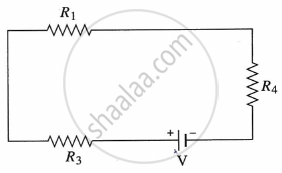
Equivalent resistance of series combination of R1, R3, R4
`R_S = R_1 + R_3 + R_4`
Current in the circuit,
`I = V/(R_1 + R_3 + R_4)`
c.
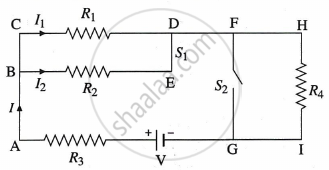
`R_P = (R_1 R_2)/(R_1 + R_2)`
`R_S = R_3 + R_4 + (R_1 R_2)/(R_1 + R_2)`
`I = V/R_S = I_3 = I_4`
Also, `I = I_1 + I_2` and `R_1 I_1 = R_2 I_2`
∴ `I = I_1 + (I_1 R_1)/R_2`
∴ `I_1(1 + R_1/R_2)`
= `(I_1(R_1 + R_2))/R_2`
`I_1 = (R_2 I)/(R_1 + R_2)`
and `I_2 = (I_1 R_1)/R_2`
= `R_1/R_2((R_1 I)/(R_1 + R_2))`
= `(R_1 I)/(R_1 + R_2)`
APPEARS IN
संबंधित प्रश्न
Draw circuit symbols for
a battery of three cells
Draw the labelled diagram of an electric circuit comprising of a cell, a resistance, an ammeter, a voltmeter and a closed switch (or closed plug key). Which of the two has a large resistance : an ammeter or a voltmeter?
Draw a circuit diagram to show how 3 bulbs can be lit from a battery so that 2 bulbs are controlled by the same switch the third bulb has its own switch.
Find the odd one out and justify it.
Fuse wire, M.C.B., Rubber Gloves, Generator
Write the condition required for a circuit to be a closed circuit.
What do you understand by the open electric circuit?
Explain the following:
Open circuit
What is the use of earthing wire?
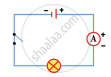
In the circuit diagram below, 10 units of electric charge move past point x every second What is the current in the circuit ______.
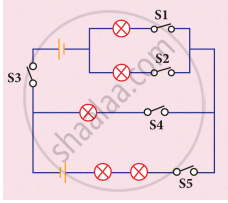
Study the electric circuit below. Which of the following switches should be closed so that only two bulbs will light up
Fuse is
State whether true or false. If false, correct the statement.
Ammeter is connected in parallel in any electric circuit.
Explain about domestic electric circuits. (circuit diagram not required)
Instead of metal wires, a jute string can be used to make a circuit.
When an electric current flows through a copper wire AB as shown in the following figure, the wire

Name the device used these days in place of electric fuses in electrical circuits.
Observe the circuit given:
1. Would any of the bulbs glow when the switch is in the ‘OFF’ position?
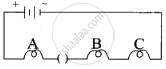
2. What will be the order in which the bulbs A, B, and C will glow when the switch is moved to the ‘ON’ position?

In the above circuit, if the current reading in the ammeter A is 2A, what would be the value of R1?
Paheli connected two bulbs to a cell as shown in the following figure.
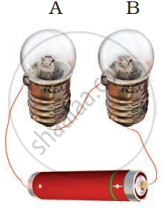
She found that filament of bulb B is broken. Will the bulb A glow in this circuit? Give reason.
An electric motor rated 1100 W is connected to 220 V mains. Find:
- The current drawn from the mains,
- Electric energy consumed if the motor is used for 5 hours daily for 6 days.
- Total cost of energy consumed if the rate of one unit is 5.
