Advertisements
Advertisements
प्रश्न
How does the short circuit form? What is its effect?
Advertisements
उत्तर
- The household electrical connections mainly consist of live, neutral and earth wires.
- The potential difference between live and neutral wires is around 220 V.
- Sometimes, due to fault in the electrical appliances or damage of the insulating coating around the two wires i.e., neutral and live, the two wires come in contact with each other and large current flows through them causing short circuit.
- Large amount of heat is produced due to flow of this large current. Any inflammable material like wood, plastic, cloth, etc. present around the short-circuited place can catch fire.
APPEARS IN
संबंधित प्रश्न
Draw a schematic diagram of a circuit consisting of a battery of three cells of 2 V each, a 5 Ω resistor, an 8 Ω resistor, and a 12 Ω resistor, and a plug key, all connected in series.
Draw circuit symbols for
fixed resistance
What is a circuit diagram
Draw a circuit diagram to show how 3 bulbs can be lit from a battery so that 2 bulbs are controlled by the same switch the third bulb has its own switch.
Explain with the help of a labelled circuit diagram how you will find the resistance of a combination of three resistors, or resistance R1, R2 and R3, joined in parallel. Also mention how you will connect the ammeter and the voltmeter in the circuit when measuring the current in the circuit and the potential difference across one of the three resistors of the combination.
Observe the following figure which bulb get fuse?

Resistances R1, R2, R3 and R4 are connected as shown in the figure. S1 and S2 are two keys. Discuss the current flowing in the circuit in the following cases.
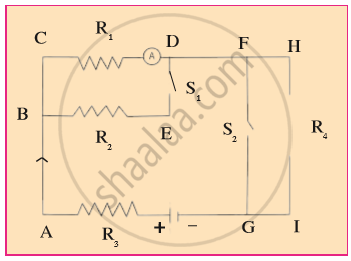
- Both S1 and S2 are closed.
- Both S1 and S2 are open.
- S1 is closed but S2 is open.
In an electric circuit, electron flow a from of point of ______ potential to the point of ______ potential.
A battery is to be formed by joining 3 dry cells with connecting wires. Show how will you connect the wires by drawing a diagram.
Distinguish between a closed circuit and an open circuit, with the use of suitable labelled diagrams.
Match the column ‘A’ with column ‘B’.
|
Column ‘A’
|
Column ‘B’ |
|
(1) Eka - boron
|
(a) Germanium
|
|
(2) Eka - Aluminium
|
(b) Scandium
|
|
(3) Eka - Silicon
|
(c) Gallium |
Name the instrument used to control current in an electric circuit.
What is open circuit?
Nowadays MCBs are used in homes, for stop the current in the circuit which suddenly increases.
Draw the circuit diagram for the series connection.
In which among the following circuits does the bulb glow?
In the circuit diagram below, 10 units of electric charge move past point x every second What is the current in the circuit ______.
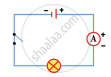
In which of the following circuits are the bulb connected in series?
Higher Order Question
A student made a circuit by using an electric cell, a switch, a torch bulb (fitted in the bulb holder), and copper connecting wires. When he turned on the switch, the torch bulb did not glow at all. The student checked the circuit and found that all the wire connections were tight.
- What could be the possible reason for the torch bulb not glowing even when the circuit appears to be complete?
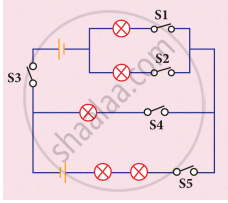
Study the electric circuit below. Which of the following switches should be closed so that only two bulbs will light up
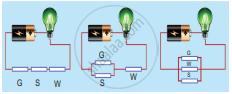
Study the three electric circuits below. Each of them has a glass rod (G), a steel rod (S), and a wooden rod (W).
In which of the electric circuits would the bulb not light up.
Which of the following a simple circuit must-have?
What is electric circuit?
In a simple circuit, why does the bulb glow when you close the switch?
When a circuit is open, _____ cannot pass through it.
______ is a kind of fish which is able to produce an electric current.
Name the device used these days in place of electric fuses in electrical circuits.
In an electric circuit a fuse is a ______ ______ to prevent possible fire.
What are the essential components of an electric circuit?
Paheli is running short of connecting wires. To complete an electric circuit, she may use a ______.
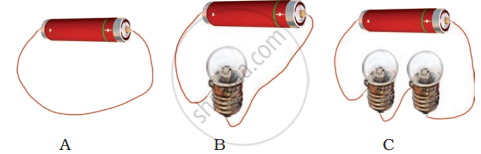
In which of the following circuits A, B and C given in the following figure, the cell will be used up very rapidly?
Write a short note on the different electrical circuits.
Overloading of electric circuits can lead to short-circuiting.
A complete circuit is left on for several minutes, causing the connecting copper wire to become hot. As the temperature of the wire increases, the electrical resistance of the wire
How is Joule's law effect useful in electric circuits where fuse is used as a safety device?
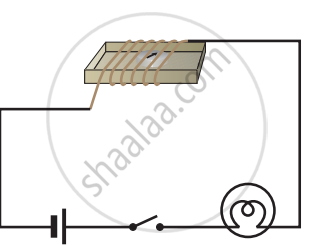
Set up the circuit shown in Figure again. Move the key to ‘ON’ position and watch carefully in which direction the compass needle gets deflected. Switch ‘OFF’ the current. Now keeping rest of the circuit intact, reverse the connections at the terminal of the cell. Again switch ‘on’ the current. Note the direction in which the needle gets deflected. Think of an explanation.