Advertisements
Advertisements
प्रश्न
Higher Order Question
A student made a circuit by using an electric cell, a switch, a torch bulb (fitted in the bulb holder), and copper connecting wires. When he turned on the switch, the torch bulb did not glow at all. The student checked the circuit and found that all the wire connections were tight.
- What could be the possible reason for the torch bulb not glowing even when the circuit appears to be complete?
Advertisements
उत्तर
The possible reasons so that even at switch ‘ON’ position the bulb is not glowing are:
- The cell may be discharge
- The bulb may be fused.
- The wire may be broken from inside
- The connection may be loose.
APPEARS IN
संबंधित प्रश्न
Draw circuit symbols for
an open switch
Draw a circuit diagram to show how 3 bulbs can be lit from a battery so that 2 bulbs are controlled by the same switch the third bulb has its own switch.
In an electric circuit, electron flow a from of point of ______ potential to the point of ______ potential.
Explain the following:
Open circuit
Nowadays MCBs are used in homes, for stop the current in the circuit which suddenly increases.
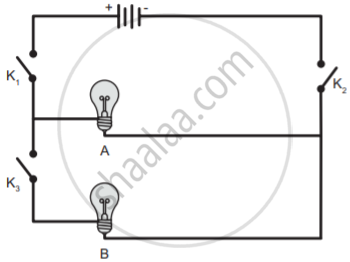
In the given circuit diagram, which of the given switch(s) should be closed. So that only bulb A glows.
Rahul wants to make an electric circuit. He has a bulb, two wires, a safety pin, and a piece of copper. He does not have any electric cell or battery. Suddenly he gets some idea. He uses lemon instead of a battery and makes a circuit. Will the bulb glow?
Draw the circuit diagram for the following series connection
Explain about domestic electric circuits. (circuit diagram not required)
How is Joule's law effect useful in electric circuits where fuse is used as a safety device?
