Advertisements
Advertisements
Question
Higher Order Question
A student made a circuit by using an electric cell, a switch, a torch bulb (fitted in the bulb holder), and copper connecting wires. When he turned on the switch, the torch bulb did not glow at all. The student checked the circuit and found that all the wire connections were tight.
- What could be the possible reason for the torch bulb not glowing even when the circuit appears to be complete?
Advertisements
Solution
The possible reasons so that even at switch ‘ON’ position the bulb is not glowing are:
- The cell may be discharge
- The bulb may be fused.
- The wire may be broken from inside
- The connection may be loose.
APPEARS IN
RELATED QUESTIONS
Draw a schematic diagram of a circuit consisting of a battery of three cells of 2 V each, a 5 Ω resistor, an 8 Ω resistor, and a 12 Ω resistor, and a plug key, all connected in series.
Explain the following:
Open circuit
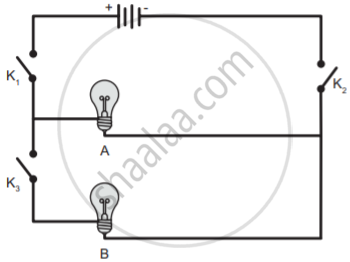
In the given circuit diagram, which of the given switch(s) should be closed. So that only bulb A glows.
Tabulate the different components of an electric circuit and their respective symbols.
Rahul wants to make an electric circuit. He has a bulb, two wires, a safety pin, and a piece of copper. He does not have any electric cell or battery. Suddenly he gets some idea. He uses lemon instead of a battery and makes a circuit. Will the bulb glow?
State whether true or false. If false, correct the statement.
Ammeter is connected in parallel in any electric circuit.
The wiring in a house consists of ______ circuits.
Draw the symbols of the following circuit components.
Switch in off position
Paheli connected two bulbs to a cell as shown in the following figure.
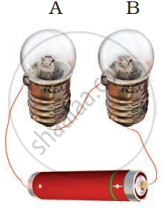
She found that filament of bulb B is broken. Will the bulb A glow in this circuit? Give reason.
Assertion: People struck by lightning receive a severe electrical shock.
Reason: Lightning carries very high voltage.
