Advertisements
Advertisements
Question
Study the three electric circuits below. Each of them has a glass rod (G), a steel rod (S), and a wooden rod (W).
In which of the electric circuits would the bulb not light up.
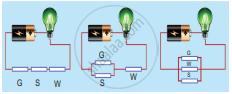
Options
A only
C only
A and B only
A , B and C
Advertisements
Solution
A and B only
APPEARS IN
RELATED QUESTIONS
Explain with the help of a labelled circuit diagram how you will find the resistance of a combination of three resistors, or resistance R1, R2 and R3, joined in parallel. Also mention how you will connect the ammeter and the voltmeter in the circuit when measuring the current in the circuit and the potential difference across one of the three resistors of the combination.
In an electric circuit, electron flow a from of point of ______ potential to the point of ______ potential.
Name the instrument used to control current in an electric circuit.
______ is the device used to close or open an electric circuit.
Rahul wants to make an electric circuit. He has a bulb, two wires, a safety pin, and a piece of copper. He does not have any electric cell or battery. Suddenly he gets some idea. He uses lemon instead of a battery and makes a circuit. Will the bulb glow?
What is electric circuit?
In a circuit, if the key is in open (off) condition, then electricity will not flow.
In an electric circuit a fuse is a ______ ______ to prevent possible fire.
Boojho has a cell and a single piece of connecting wire. Without cutting the wire in two, will he be able to make the bulb glow? Explain with the help of a circuit diagram.
How is Joule's law effect useful in electric circuits where fuse is used as a safety device?
