Advertisements
Advertisements
Question
Match the column ‘A’ with column ‘B’.
|
Column ‘A’
|
Column ‘B’ |
|
(1) Eka - boron
|
(a) Germanium
|
|
(2) Eka - Aluminium
|
(b) Scandium
|
|
(3) Eka - Silicon
|
(c) Gallium |
Advertisements
Solution
|
Column ‘A’
|
Column ‘B’
|
|
(1) Eka - boron
|
(b) Scandium |
|
(2) Eka - Aluminium
|
(c) Gallium |
|
(3) Eka - Silicon
|
(a) Germanium |
APPEARS IN
RELATED QUESTIONS
Draw a schematic diagram of a circuit consisting of a battery of three cells of 2 V each, a 5 Ω resistor, an 8 Ω resistor, and a 12 Ω resistor, and a plug key, all connected in series.
Redraw the circuit of question 1, putting in an ammeter to measure the current through the resistors and a voltmeter to measure the potential difference across the 12 Ω resistors. What would be the readings in the ammeter and the voltmeter?
Draw circuit symbols for
a battery of three cells
Draw circuit symbols for
A closed switch
Draw a circuit diagram to show how 3 bulbs can be lit from a battery so that 2 bulbs are controlled by the same switch the third bulb has its own switch.
Explain with the help of a labelled circuit diagram how you will find the resistance of a combination of three resistors, or resistance R1, R2 and R3, joined in parallel. Also mention how you will connect the ammeter and the voltmeter in the circuit when measuring the current in the circuit and the potential difference across one of the three resistors of the combination.
Tell the odd one out. Give a proper explanation.
Who will spend more electrical energy? 500 W TV Set in 30 mins, or 600 W heater in 20 mins?
Find the odd one out and justify it.
Fuse wire, M.C.B., Rubber Gloves, Generator
Resistances R1, R2, R3 and R4 are connected as shown in the figure. S1 and S2 are two keys. Discuss the current flowing in the circuit in the following cases.
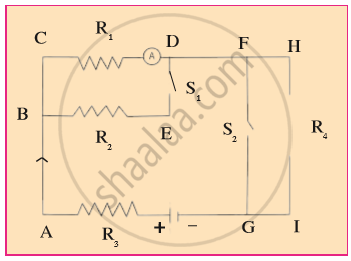
- Both S1 and S2 are closed.
- Both S1 and S2 are open.
- S1 is closed but S2 is open.
The accompanying figure shows some electrical appliances connected in a circuit in a house. Answer the following questions.

- By which method are the appliances connected?
- What must be the potential difference across individual appliances?
- Will the current passing through each appliance be the same? Justify your answer.
- Why are the domestic appliances connected in this way?
- If the T.V. stops working, will the other appliances also stop working? Explain your answer.
Distinguish between a closed circuit and an open circuit, with the use of suitable labelled diagrams.
Explain the following:
Closed circuit
Find the odd one out and give its explanation.
Right or wrong sentence.
Increasing the current passing through the wire decreases the magnetic field intensity.
What is the use of earthing wire?
Flow of electricity through a closed circuit is _____.
The switch is used to close or open an electric circuit.
In the circuit diagram below, 10 units of electric charge move past point x every second What is the current in the circuit ______.
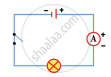
_____ has a thin metallic filament that melts and breaks the connection when the circuit is overheated.
When a circuit is open, _____ cannot pass through it.
What is the role of the earth wire in domestic circuits?
______ is a kind of fish which is able to produce an electric current.
In an electric circuit, the current starts from ______.
Three bulbs A, B, C are connected in a circuit as shown in the following figure. When the switch is ‘ON’
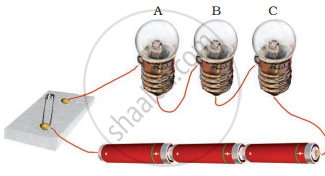
In an electric circuit a fuse is a ______ ______ to prevent possible fire.
The ______ is a species of fish that can give electric shocks of up to six hundred fifty watts of electricity.
Will the bulb glow in the circuit shown in the following figure? Explain.
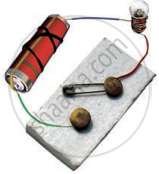
Paheli connected two bulbs to a cell as shown in the following figure.
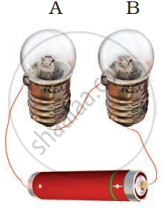
She found that filament of bulb B is broken. Will the bulb A glow in this circuit? Give reason.
Boojho has a cell and a single piece of connecting wire. Without cutting the wire in two, will he be able to make the bulb glow? Explain with the help of a circuit diagram.
Overloading of electric circuits can lead to short-circuiting.
