Advertisements
Advertisements
Question
Choose the correct alternative and rewrite the following:
Mirror used by a dental surgeon is ..........................
Options
plane
convex
concave
convex and concave
Advertisements
Solution
concave
APPEARS IN
RELATED QUESTIONS
An image that cannot be obtained on a screen is called ______.
Find out the letters of English alphabet or any other language known to you in which the image formed in a plane mirror appears exactly like the letter itself. Discuss your findings.
What is a virtual image?
A diverging lens is used in ______.
State the direction of incident ray which after reflection from a spherical mirror gets reflected along its own path. Give a reason.
Mention the types of mirrors used as (i) rear view mirrors, (ii) shaving mirrors. List two reasons to justify your answers in each case.
State the number of images of an object placed between two mirrors, formed in each case when mirrors are inclined to each other at (a) 90°, and (b) 60°.
Figure shows a concave mirror with its pole at P, focus F and centre of curvature C. Draw ray diagram to show the formation of image of an object OA.
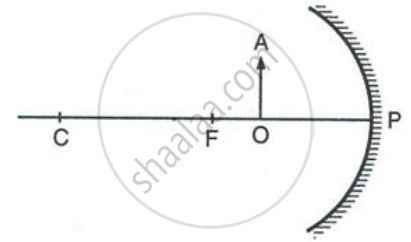
Name the kind of mirror used to obtain:
A virtual and diminished image
Which mirror will you prefer to use as a rear view mirror in a car : plane mirror or convex mirror? Give one reason.
The image formed by a convex mirror is of size one third the size of object. How are u and v related?
Select the correct option:
A mirror forms a virtual image (diminished) of an object, whatever be the position of object:
The boxes in figure (a, b, c) represent mirrors; insert a mirror which will reflect the incident ray as shown in the diagram.
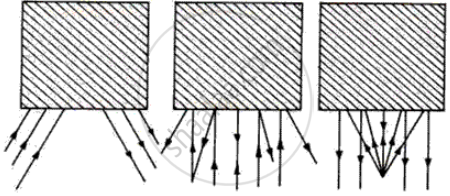
What is the relationship between the focal length and radius of curvature?
Name the type of mirror used in the following situation:
Side/rear-view mirror of a vehicle
Support your answer with reason.
Spherical mirrors are one form of ______ mirrors.
Name the two types of spherical mirrors.
