Advertisements
Advertisements
Question
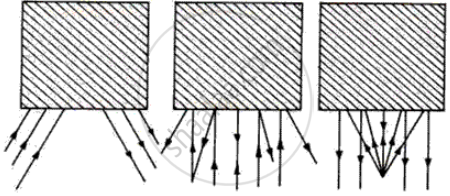
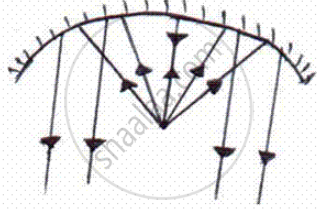
The boxes in figure (a, b, c) represent mirrors; insert a mirror which will reflect the incident ray as shown in the diagram.
Advertisements
Solution
a. Plane Mirror
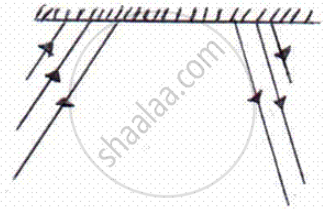
b. Convex Mirror
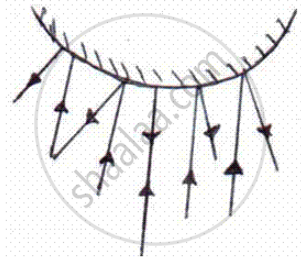
c. Concave Mirror
APPEARS IN
RELATED QUESTIONS
Define the following term in the context of spherical mirrors:- Principal focus
The diverging lens in part (a) is replaced by a converging lens also of focal length 100 mm. The object remains in the same position and an image is formed by the converging lens. Compare two properties of this image with those of the image formed by the diverging lens in part (a).
Explain the meaning of the terms focus and focal length in case of a convex mirror, with the help of suitable ray diagram.
What type of mirror can be used to obtain a real image of an object?
What is meant by magnification? Write its expression. What is its sign for the (a) real (b) virtual, image?
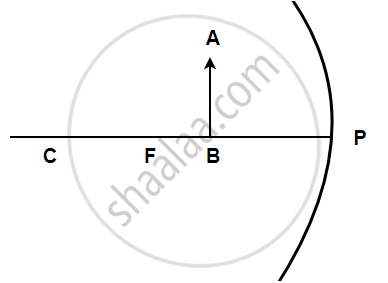
In the following figure shows a concave mirror with its pole (P), focus (F) and centre of curvature (C). Draw a ray diagram to show the formation of the image of an object AB by the concave mirror.
A concave mirror can be used to produce a parallel beam of light. Draw a ray to illustrate this.
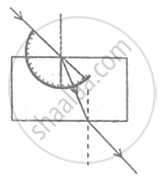
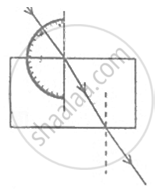
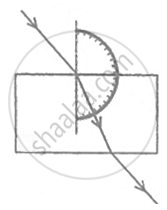
A student traces the path of a ray of light passing through a rectangular slab.
 |
 |
 |
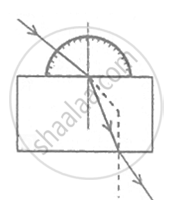 |
For measuring the angle of incidence, he must position the protractor in the manner shown in the figure:
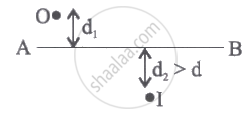
In the figure shown, the image of a real object is formed at the point I. AB is the principal axis of the mirror. The mirror must be: