Advertisements
Advertisements
प्रश्न
The boxes in figure (a, b, c) represent mirrors; insert a mirror which will reflect the incident ray as shown in the diagram.
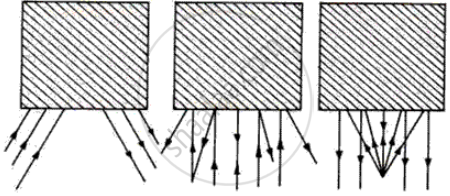
Advertisements
उत्तर
a. Plane Mirror
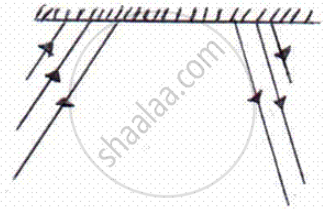
b. Convex Mirror
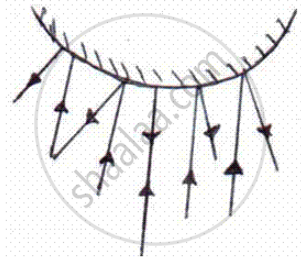
c. Concave Mirror
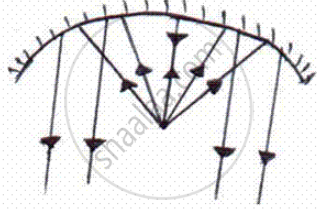
APPEARS IN
संबंधित प्रश्न
Match the items given in Column I with one or more items of Column II.
| Column I | Column II | ||
| (a) | A plane mirror | (i) | Used as a magnifying glass. |
| (b) | A convex mirror | (ii) | Can form image of objects spread over a large area. |
| (c) | A convex lens | (iii) | Used by dentists to see enlarged image of teeth. |
| (d) | A concave mirror | (iv) | The image is always inverted and magnified. |
| (e) | A concave lens | (v) | The image is erect and of the same size as the object. |
| (vi) | The image is erect and smaller in size than the object. |
Name the spherical mirror which can produce a real and diminished image of an object.
The shiny outer surface of a hollow sphere of aluminium of radius 50 cm is to be used as a mirror:
- What will be the focal length of this mirror?
- Which type of spherical mirror will it provide?
- State whether this spherical mirror will diverge or converge light rays.
State the kind of mirror used
(a) by a dentist, and
(b) as a street light reflector.
Name the two kinds of spherical mirrors and distinguish between them.
Name the spherical mirror which (i) diverges (ii) converges the beam of light incident on it. Justify your answer by drawing a ray diagram in each case.
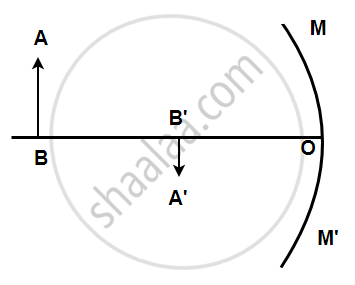
AB is the object, A'B' is the image, and MM' is the position of the mirror. Complete the ray diagram showing the formation of the image and find the focal length of the mirror.
A ray of light is incident towards a plane mirror at an angle of 30° with the mirror surface. What will be the angle of reflection?
What is “aperture”?
