Advertisements
Advertisements
प्रश्न
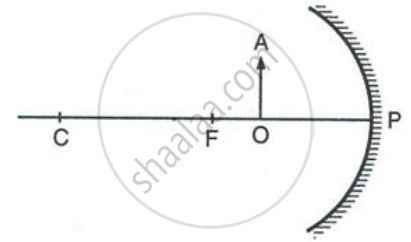
Figure shows a concave mirror with its pole at P, focus F and centre of curvature C. Draw ray diagram to show the formation of image of an object OA.
Advertisements
उत्तर

APPEARS IN
संबंधित प्रश्न
The shiny outer surface of a hollow sphere of aluminium of radius 50 cm is to be used as a mirror:
Which type of spherical mirror will it provide?
A diverging lens is used in ______.
How is a spherical mirror used to converge a beam of light at a point? Name the type of mirror used.
An object 5 cm high is placed at a distance 60 cm in front of a concave mirror of focal length 10 cm. Find the position and size of the image.
A straight stick partly dipped in water obliquely appears to be bent at the surface of the water.
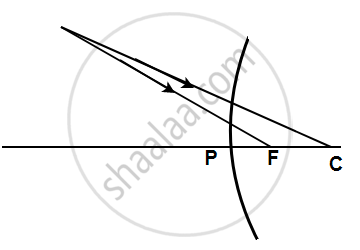
Complete the following diagrams shown in the below figure by drawing the reflected ray for each incident ray.
A converging lens of focal length f is placed at a distance 0.3 m from an object to produce an image on a screen 0.9 m from the lens. With the object and the screen in the same positions, an image of the object could also be produced on the screen by placing a converging lens of focal length.
