Advertisements
Advertisements
प्रश्न
Size of image of an object by a mirror having a focal length of 20 cm is observed to be reduced to 1/3rd of its size. At what distance the object has been placed from the mirror? What is the nature of the image and the mirror?
Advertisements
उत्तर
Case I: (In case of convex mirror)
Magnification, `"m" = 1/3` (convex mirror)
Focal length (f) = 20 cm
Size of image `("h"_"i") = 1/3 xx "h"_"o"` (Size of object)
Using the magnification formula,
`"m" = "h"_"i"/"h"_"o" = (-upsilon)/"u"`
Substituting the values in the above equation,
`("h"_"o"/3)/"h"_"o" = (-upsilon)/"u"`
`1/3 = (-upsilon)/"u"`
`upsilon = (-"u")/3`
Using the mirror formula,
`1/upsilon + 1/"u" = 1/"f"`
`(-3)/"u" + 1/"u" = 1/20`
`(-2)/"u" = 1/20`
u = -40 cm
Negative sign shows that the object is in front of the mirror.
Substituting the above value in obtained image distance and object distance relation,
`upsilon = -u/3 = - ((-40))/3 = 40/3` cm
Thus, the image formed is virtual, erect and diminished. The object is at a distance of 40 cm from the mirror.
Case II: In case of concave mirror
Magnification, `"m" = -1/3` (concave mirror)
Focal length (f) = -20 cm
Using the magnification formula,
`"m" = "h"_"i"/"h"_"o" = (-upsilon)/"u"`
Substituting the values in the above equation,
`(-1)/3 = (-upsilon)/"u"`
`1/3 = upsilon/"u"`
`upsilon = "u"/3`
Using the mirror formula,
`1/upsilon + 1/"u" = 1/"f"`
`3/"u" + 1/"u" = 1/(-20)`
`4/"u" = 1/(-20)`
u = -80 cm
`upsilon = "u"/3 = -80/3` cm
Thus, the image will be real and inverted. The object is at a distance of 80 cm from the mirror.
APPEARS IN
संबंधित प्रश्न
Define the following term in the context of spherical mirrors:- Pole
What is the name of the phenomenon in which the right side of an object appears to be the left side of the image in a plane mirror?
Name the spherical mirror which can produce a real and diminished image of an object.
How is a spherical mirror used to diverge a beam of light from a point? Name the type of mirror used.
Define the terms focus and focal length of a concave mirror. Draw diagram to illustrate your answer.
State the two convenient rays that are chosen to construct the image by a spherical mirror for a given object? Explain your answer with the help of suitable ray diagrams.
State whether the image in part (a) is real or virtual?
Draw a ray diagram to show the formation of the image, when the object is placed between optical centre and principal focus of a convex lens.
State the signs and values of magnifications in the above mentioned case.
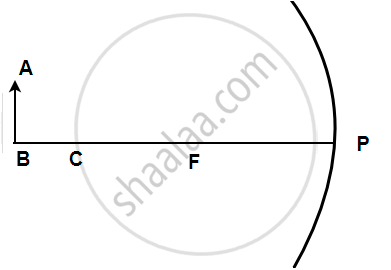
The following figure shows a concave mirror with its pole (P), focus (F), and center of curvature (C). Draw a ray diagram to show the formation of the image of an object AB by the concave mirror.
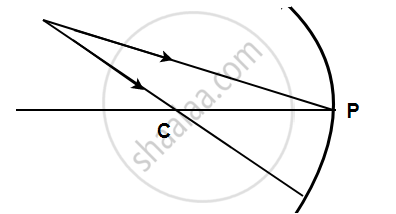
Complete the following diagrams shown in the following figures by drawing the reflected rays.
The spherical mirror used as a rear view mirror in the vehicle is
Name the type of mirror used in the following situation:
Solar furnace
Support your answer with reason.
What is the difference between virtual images of an object formed by a concave mirror and a convex mirror?
A ray of light is incident towards a plane mirror at an angle of 30° with the mirror surface. What will be the angle of reflection?
Define the radius of curvature.
