Advertisements
Advertisements
प्रश्न
Visit a nearby hospital. You can also visit the clinic of an ENT specialist, or a dentist. Request the doctor to show you the mirrors used for examining ear, nose, throat and teeth. Can you recognise the kind of mirror used in these instruments?
Advertisements
उत्तर
Visit to a Hospital
Activity:
- Visit a nearby hospital, the clinic of an ENT specialist, or a dentist.
- Request the doctor to show you the mirrors used for examining the ear, nose, throat, and teeth.
- Observe the mirrors and try to recognize the kind of mirrors used in these instruments.
Observation:
- Doctors use small, specially designed mirrors in their instruments to examine patients' ears, nose, throat, and teeth.
Explanation:
The mirrors used in these medical instruments are typically concave mirrors.
-
- Concave Mirrors: These mirrors are curved inward, allowing them to focus light onto a specific area. They provide a clear and magnified view of small and detailed structures like the ear canal, nasal passages, throat, and teeth.
Conclusion:
- Concave mirrors are commonly used in medical instruments to examine the ear, nose, throat, and teeth. They help doctors by focusing light and providing a magnified and clear view of the specific areas being examined.
APPEARS IN
संबंधित प्रश्न
Define the following term in the context of spherical mirrors:- Principal focus
Define Radius of curvature of the spherical mirror
Upto what maximum distance from the pole the image in a convex mirror can be obtained? what will be the location of object then ?
Select the correct option:
A concave mirror is made by cutting a portion of a hollow glass sphere of radius 30 cm. The focal length of the concave mirror is:
What do you understand by the term real image?
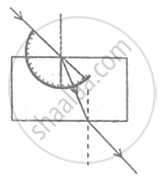
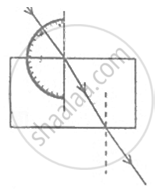
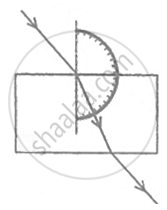
A student traces the path of a ray of light passing through a rectangular slab.
 |
 |
 |
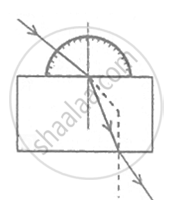 |
For measuring the angle of incidence, he must position the protractor in the manner shown in the figure:
A shopkeeper wanted to fix a mirror which will give a maximum view of his shop. What type of mirror should he use? Give reason.
What is the difference between virtual images of an object formed by a concave mirror and a convex mirror?
