Advertisements
Advertisements
प्रश्न
Advertisements
उत्तर
difference between real and virtual images.
| Real images | Virtual images |
| it can be obtained on a screen | It can't be obtained on a screen |
| it is inverted (upside down with respect to the object) | It is erect with respect to the object |
| It is formed when two or more reflected rays intersect each other at a point in front of the mirror | It is formed when two or more reflected rays appear to intersect at a point behind the mirror |
संबंधित प्रश्न
What is the name of the phenomenon in which the right side of an object appears to be the left side of the image in a plane mirror?
How is a spherical mirror used to converge a beam of light at a point? Name the type of mirror used.
Name the kind of mirror used to obtain:
A virtual and diminished image
A point light source is kept in front of a convex mirror at a distance of 40 cm. The focal length of the mirror is 40 cm. Find the position of image.
Define the following term in relation to concave mirror.
Principal axis
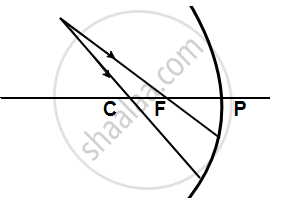
Complete the following diagrams shown in the below figure by drawing the reflected ray for each incident ray.
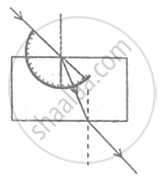
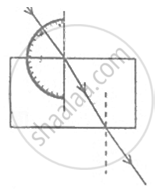
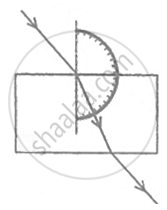
A student traces the path of a ray of light passing through a rectangular slab.
 |
 |
 |
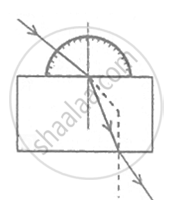 |
For measuring the angle of incidence, he must position the protractor in the manner shown in the figure:
The radius of curvature of a spherical mirror is 18 cm. What is the focal length of this mirror?
