Advertisements
Advertisements
प्रश्न
The diverging lens in part (a) is replaced by a converging lens also of focal length 100 mm. The object remains in the same position and an image is formed by the converging lens. Compare two properties of this image with those of the image formed by the diverging lens in part (a).
Advertisements
उत्तर
| S.No | Image formed by a diverging lens | Image formed by a converging lens |
| 1 | Image formed is virtual and erect | Image formed is real and inverted |
| 2 | Image is smaller in size than the object | Image is larger in size than the object |
संबंधित प्रश्न
Define the following term in the context of spherical mirrors:- Pole
A concave mirror always forms a real image.
Give one use each of a concave and a convex mirror.
Name the spherical mirror which can produce a virtual and diminished image of an object.
What is a spherical mirror?
AB and CD, two spherical mirrors, from parts of a hollow spherical ball with its centre at O as shown in the diagram. If arc AB = `1/2` arc CD, what is the ratio of their focal lengths? State which of the two mirrors will always form virtual image of an object placed in front of it and why.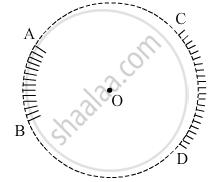
What type of mirror can be used to obtain a real image of an object?
An object is placed at 4 cm distance in front of a concave mirror of radius of curvature 24 cm. Find the position of image. Is the image magnified?
What do you understand by the term real image?
AB is the object, A'B' is the image, and MM' is the position of the mirror. Complete the ray diagram showing the formation of the image and find the focal length of the mirror.
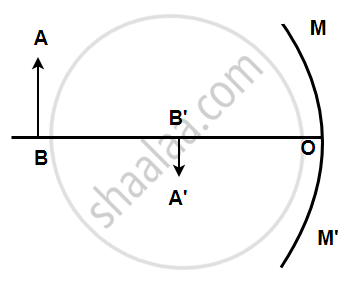
Define the term Pole.
Numerical problem.
The radius of curvature of a spherical mirror is 25 cm. Find its focal length.
Name the two types of spherical mirrors.
The radius of curvature of a spherical mirror is 18 cm. What is the focal length of this mirror?
How tall does a mirror have to be to fit an entire person’s body?
Define the radius of curvature.
