Advertisements
Advertisements
प्रश्न
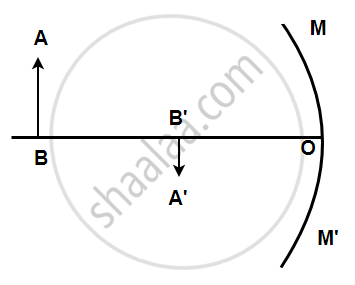
AB is the object, A'B' is the image, and MM' is the position of the mirror. Complete the ray diagram showing the formation of the image and find the focal length of the mirror.
Advertisements
उत्तर
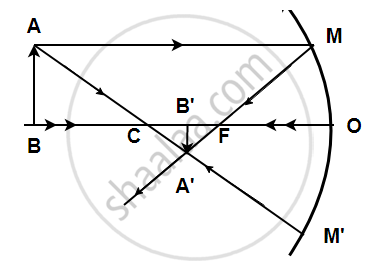
A light ray coming from a point on object AB is reflected from the surface of the mirror, it passes through the principal focus and the other ray passing through the center of curvature strikes the mirror normally i.e. 90 degrees. Hence it will reflect back. These two reflected rays coincide at a point where the image is formed. The image, A'B' is real, inverted, and diminished in size. The focal length was found to be 16 mm.
APPEARS IN
संबंधित प्रश्न
Explain the following term related to spherical lenses:- centres of curvature
Image formed by a convex ______ is always virtual and smaller in size.
Which type of mirror can form a real image?
What is the name of the phenomenon in which the right side of an object appears to be the left side of the image in a plane mirror?
State the direction of incident ray which after reflection from a spherical mirror gets reflected along its own path. Give a reason.
Name the kind of mirror used to obtain:
A real and diminished image.
What is meant by magnification? Write its expression. What is its sign for the (a) real (b) virtual, image?
(a) When a concave mirror is used as a shaving mirror, where is the person's face in relation to the focus of mirror?
(b) State three characteristics of the image seen in part (a).
