Advertisements
Advertisements
प्रश्न
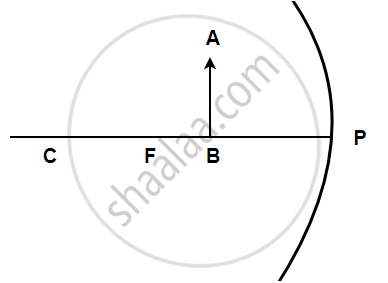
Does the mirror mentioned in part (b) form real image for all locations of the object?
Advertisements
उत्तर
No, it does not form real image for all locations of the object.
APPEARS IN
संबंधित प्रश्न
A virtual image larger than the object can be produced by a ______.
When a spherical mirror is held towards the sun and its sharp image is formed on a piece of a carbon paper for some time, a hole is burnt in the carbon paper.
What name is given to the distance between spherical mirror and carbon paper?
How is the focal length of a spherical mirror related to its radius
AB and CD, two spherical mirrors, from parts of a hollow spherical ball with its centre at O as shown in the diagram. If arc AB = `1/2` arc CD, what is the ratio of their focal lengths? State which of the two mirrors will always form virtual image of an object placed in front of it and why.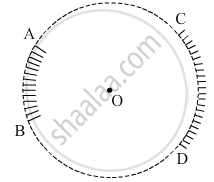
(a) When a concave mirror is used as a shaving mirror, where is the person's face in relation to the focus of mirror?
(b) State three characteristics of the image seen in part (a).
Select the correct option:
Looking into a mirror one finds her image diminished, the mirror is:
Find the height of the image of a body of height 1.5m in a mirror with a magnification of 1.5.
In the following figure shows a concave mirror with its pole (P), focus (F) and centre of curvature (C). Draw a ray diagram to show the formation of the image of an object AB by the concave mirror.