Advertisements
Advertisements
प्रश्न
Two tungsten bulbs of power 50 W and 60 W work on 220 V potential difference. If they are connected in parallel, how much current will flow in the main conductor?
Advertisements
उत्तर
Given: P1 = 50 W, P2 = 60 W and V = 220 V
To find I = ?
Formula: P = VI
We know,
Total Power (P) = P1 + P2
= 50 + 60
= 110 W
We know, P = VI
⇒ I = `"P"/"V"`
= `110/220`
= `1/2`
I = 0.5 A
The current of 0.5 A will flow in the main conductor.
APPEARS IN
संबंधित प्रश्न
What do the following symbols mean in circuit diagrams?
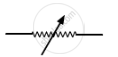
What do the following symbols mean in circuit diagrams?
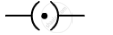
Draw circuit symbols for
fixed resistance
What is a circuit diagram
Draw the labelled diagram of an electric circuit comprising of a cell, a resistance, an ammeter, a voltmeter and a closed switch (or closed plug key). Which of the two has a large resistance : an ammeter or a voltmeter?
Draw a circuit diagram to show how 3 bulbs can be lit from a battery so that 2 bulbs are controlled by the same switch the third bulb has its own switch.
Explain with the help of a labelled circuit diagram how you will find the resistance of a combination of three resistors, or resistance R1, R2 and R3, joined in parallel. Also mention how you will connect the ammeter and the voltmeter in the circuit when measuring the current in the circuit and the potential difference across one of the three resistors of the combination.
Explain the construction and working of the following. Draw a neat diagram and label it.
Electric motor
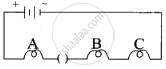
Observe the following figure which bulb get fuse?

Match the column ‘A’ with column ‘B’.
|
Column ‘A’
|
Column ‘B’ |
|
(1) Eka - boron
|
(a) Germanium
|
|
(2) Eka - Aluminium
|
(b) Scandium
|
|
(3) Eka - Silicon
|
(c) Gallium |
Answer the following question.
With the help of a suitable circuit diagram prove that the reciprocal of the equivalent resistance of a group of resistances joined in parallel is equal to the sum of the reciprocals of the individual resistances.
Draw a neat diagram showing a closed electric circuit.
Draw a neat diagram showing a open electric circuit.
Explain the following:
Closed circuit
The unit of electrical power is _______.
What is the use of earthing wire?
______ is the device used to close or open an electric circuit.
The switch is used to close or open an electric circuit.
In which of the following circuits are the bulb connected in series?
Higher Order Question
A student made a circuit by using an electric cell, a switch, a torch bulb (fitted in the bulb holder), and copper connecting wires. When he turned on the switch, the torch bulb did not glow at all. The student checked the circuit and found that all the wire connections were tight.
- What could be the possible reason for the torch bulb not glowing even when the circuit appears to be complete?
Explain about domestic electric circuits. (circuit diagram not required)
A device that is used to break an electric circuit is called ______.
In a circuit, if the key is in open (off) condition, then electricity will not flow.
What are the types of electric circuits?
In an electrical circuit three incandescent bulbs A, B and C of rating 40 W, 60 W and 100 W respectively are connected in parallel to an electric source. Which of the following is likely to happen regarding their brightness?
When an electric current flows through a copper wire AB as shown in the following figure, the wire

Choose the statement which is not correct in the case of an electric fuse.
Our body is a ______ of electricity.
Draw the symbols of the following circuit components.
Switch in off position
Observe the circuit given:
1. Would any of the bulbs glow when the switch is in the ‘OFF’ position?
2. What will be the order in which the bulbs A, B, and C will glow when the switch is moved to the ‘ON’ position?
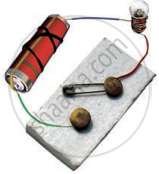
Will the bulb glow in the circuit shown in the following figure? Explain.
Paheli connected two bulbs to a cell as shown in the following figure.
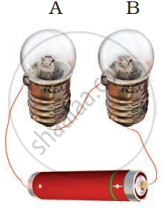
She found that filament of bulb B is broken. Will the bulb A glow in this circuit? Give reason.
Overloading of electric circuits can lead to short-circuiting.
A complete circuit is left on for several minutes, causing the connecting copper wire to become hot. As the temperature of the wire increases, the electrical resistance of the wire
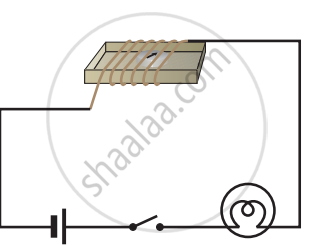
Set up the circuit shown in Figure again. Move the key to ‘ON’ position and watch carefully in which direction the compass needle gets deflected. Switch ‘OFF’ the current. Now keeping rest of the circuit intact, reverse the connections at the terminal of the cell. Again switch ‘on’ the current. Note the direction in which the needle gets deflected. Think of an explanation.