Advertisements
Advertisements
प्रश्न
Give scientific reason :
In the electric equipment producing heat e.g. iron, electric heater, boiler, toaster, etc., an alloy such as Nichrome is used, not pure metals.
Advertisements
उत्तर
Resistivity of alloys like nichrome is more than pure metals so they will get heated easily on the passage of a small amount of current. They also have a high melting point and do not oxidize readily at high temperature. So in the electric equipment producing heat e.g. iron, electric heater, boiler, toaster etc, an alloy such as Nichrome is used, not pure metals.
APPEARS IN
संबंधित प्रश्न
Compute the heat generated while transferring 96000 coulomb of charge in one hour through a potential difference of 50 V.
Why is the tungsten used almost exclusively for filament of electric lamps?
When current is switched ‘on’ in a room heater, it ______.
The safety device based on the heating effect of electric current is called a ______.
An electric heater is connected to the 230 V mains supply. A current of 8 A flows through the heater.
(b) How much energy is transferred to the heater each second?
An electric kettle rated at 220 V, 2.2 kW, works for 3 hours. Find the energy consumed and the current drawn.
Explain why, the current that makes the heater element very hot, only slightly warms the connecting wires leading to the heater.
A heating coil has a resistance of 200 Ω. At what rate will heat be produced in it when a current of 2.5 A flows through it?
How much heat will an instrument of 12 W produce in one minute if it is connected to the heat produced by it?
What is meant by the heating effect of current?
The elements of electrical heating devices are usually made of:
(a) tungsten
(b) bronze
(c) nichrome
(d) argon
The heat produced in a wire of resistance 'x' when a current 'y' flows through it in time 'z' is given by:
(a) x2 × y × z
(b) x × z × y2
(c) y × z2 × x
(d) y × z × x
Which electric heating device in your home do you think have resistors which control the flow of electricity?
Give Scientific reasons.
In the electric equipment producing heat e.g. iron, electric heater, boiler, toaster etc, an alloy such as Nichrome is used, not pure metals.
Solve the following example.
Two tungsten bulbs of wattage 100 W and 60 W power work on 220 V potential difference. If they are connected in parallel, how much current will flow in the main conductor?
An electric iron of 1100 W is operated for 2 hrs daily. What will be the electrical consumption expenses for that in the month of April? (The electric company charges Rs 5 per unit of energy).
Answer the following question:
what is the heating effect of the electric current? state any four applications of it?
In an electric bulb, coil of _______ metal is used.
These days when current in the circuit suddenly increases _______ switches are used.
A coil of an alloy _______ is used in electric heater cooker as a resistor.
Which of the following substance contracts on heating?
What does overloading cause?
Mark the correct choice
- Assertion: Electric appliances with a metallic body have three wire connections.
- Reason: Three-pin connections reduce the heating of the connecting wires.
A fuse wire repeatedly gets burnt when used with a good heater. It is advised to use a fuse wire of:
Which of the following gases are filled in electric bulbs?
B1, B2 and B3 are three identical bulbs connected as shown in Figure. When all the three bulbs glow, a current of 3A is recorded by the ammeter A.
- What happens to the glow of the other two bulbs when the bulb B1 gets fused?
- What happens to the reading of A1, A2, A3 and A when the bulb B2 gets fused?
- How much power is dissipated in the circuit when all the three bulbs glow together?
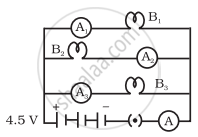
When a switch is in OFF position,
- circuit starting from the positive terminal of the cell stops at the switch.
- circuit is open.
- no current flows through it.
- current flows after some time.
Choose the combination of correct answer from the following.
An electric cell produces electricity from the ______ ______ in it.
Your teacher has shown you the following activity.
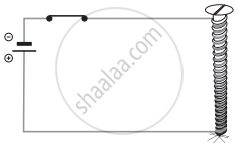
Activity: Teacher has wound a long insulated piece of wire around an iron nail in the form of a coil. Free ends of the wire are connected to a cell through a switch as shown in the following figure. The current is switched on and some pins are placed near the ends of the nail.
Write down any three questions that come to your mind about this activity.
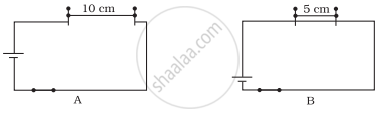
Paheli took a wire of length 10 cm. Boojho took a wire of 5 cm of the same material and thickness. Both of them connected the wires as shown in the circuit given in the following figure. The current flowing in both the circuits is the same.
- Will the heat produced in both cases be equal? Explain.
- Will the heat produced be the same if the wires taken by them are of equal lengths but of different thickness? Explain.
What is a trip switch?
A trip switch is a ______ safety device.
1 kWh is equal to ______.
Write an expression for the amount of heat produced in a resistor when an electric current is passed through it stating the meanings of the symbols used.
State the law that explains the heating effect of current with respect to the measurable properties in an electrical circuit.
Anannya responded to the question: Why do electrical appliances with metallic bodies are connected to the mains through a three-pin plug, whereas an electric bulb can be connected with a two-pin plug?
She wrote: Three-pin connections reduce heating of connecting wires.
- Is her answer correct or incorrect? Justify.
- What is the function of a fuse in a domestic circuit?
