Advertisements
Advertisements
Question
How can overloading be avoided?
Advertisements
Solution
Overloading in the electric circuit can be avoided by not connecting many electric appliances at a time in the circuit.
APPEARS IN
RELATED QUESTIONS
An electric heater of resistance 8 Ω draws 15 A from the service mains 2 hours. Calculate the rate at which heat is developed in the heater.
Why is the tungsten used almost exclusively for filament of electric lamps?
Write Joule's law of heating.
An electric room heater draws a current of 2.4 A from the 120 V supply line. What current will this room heater draw when connected to 240 V supply line?
What is nichrome? State its one use.
How does the resistance of a wire vary with its:
diameter?
Why does the connecting cord of an electric heater not glow hot while the heating element does?
Explain why, tungsten is used for making the filaments of electric bulbs.
How much heat will an instrument of 12 W produce in one minute if it is connected to the heat produced by it?
The elements of electrical heating devices are usually made of:
(a) tungsten
(b) bronze
(c) nichrome
(d) argon
If the current flowing through a fixed resistor is halved, the heat produced in it will become:
Two exactly similar heating resistances are connected (i) in series, and (ii) in parallel, in two different circuits, one by one. If the same current is passed through both the combinations, is more heat obtained per minute when they are connected in series or when they are connected in parallel? Give reason for your answer.
Identify the figure and give its use.
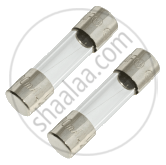
Identify the figure and give its use.
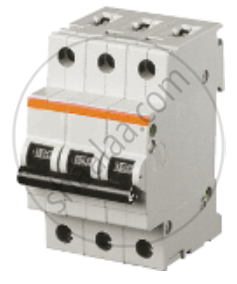
Solve the following example.
Two tungsten bulbs of wattage 100 W and 60 W power work on 220 V potential difference. If they are connected in parallel, how much current will flow in the main conductor?
Name any six domestic appliances based on the heating effect of electric current.
Rewrite the following statement by selecting the correct option:
1 A = ____________ mA.
The ‘live’ and the ‘neutral’ wires have potential difference of _______.
In an electric bulb, coil of _______ metal is used.
A coil of an alloy _______ is used in electric heater cooker as a resistor.
What is overloading?
True or False – If False give the correct answer
The fuse wire does not melts whenever there is overload in the wiring.
Name some devices that run using heat effect of electric current
Explain the heating effect of electric current.
Which of the following is correct?
Which of the following gases are filled in electric bulbs?
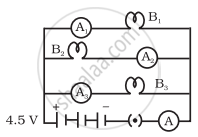
B1, B2 and B3 are three identical bulbs connected as shown in Figure. When all the three bulbs glow, a current of 3A is recorded by the ammeter A.
- What happens to the glow of the other two bulbs when the bulb B1 gets fused?
- What happens to the reading of A1, A2, A3 and A when the bulb B2 gets fused?
- How much power is dissipated in the circuit when all the three bulbs glow together?
Can we use the same fuse in a geyser and a television set? Explain.
An electric fuse has a body made of ceramic and two points for connecting the fuse wire.
______ wire is used in the filament of the bulbs.
Name the effect of the current responsible for the glow of the bulb in an electrical circuit.
The electric fuse works on the Joule heating principle.
In the electric equipment producing heat like iron, electric heater, boiler, toaster etc., an alloy such as nichrome is used, not pure metals.
State the law that explains the heating effect of current with respect to the measurable properties in an electrical circuit.
Anannya responded to the question: Why do electrical appliances with metallic bodies are connected to the mains through a three-pin plug, whereas an electric bulb can be connected with a two-pin plug?
She wrote: Three-pin connections reduce heating of connecting wires.
- Is her answer correct or incorrect? Justify.
- What is the function of a fuse in a domestic circuit?
An electric iron of resistance 20 Ω draws a current of 5 A. The heat developed in the iron in 30 seconds is ______.
An electric iron is rated 220 V, 2 kW. If the iron is used for 3h daily find the cost of running it for one week if it costs ₹ 4.25 per kWh.
