Advertisements
Advertisements
Question
In the electric equipment producing heat like iron, electric heater, boiler, toaster etc., an alloy such as nichrome is used, not pure metals.
Advertisements
Solution
The performance and life of a heating element are determined by the material used to make the heating element. The heating element material must have a high melting point, high tensile strength, high resistivity, and a low-temperature coefficient of resistance. Because an alloy's resistivity is greater than that of pure metal, alloys are employed in electrical heating devices rather than pure metals. Furthermore, even at greater temperatures, the alloy does not easily burn (or oxidise).
APPEARS IN
RELATED QUESTIONS
State four most common electrical appliances based on heating effect of electric current. Why do we use finely heated platinum wire in surgery?
An electric heater of resistance 8 Ω draws 15 A from the service mains 2 hours. Calculate the rate at which heat is developed in the heater.
When current is switched ‘on’ in a room heater, it ______.
Write Joule's law of heating.
What is nichrome? State its one use.
How does the resistance of a wire vary with its:
diameter?
Why does the connecting cord of an electric heater not glow hot while the heating element does?
Write down the formula for the heat produced when a current I is passed through a resistor R for time t.
Explain why, tungsten is used for making the filaments of electric bulbs.
The heat produced by passing an electric current through a fixed resistor is proportional to the square of:
(a) magnitude of resistance of the resistor
(b) temperature of the resistor
(c) magnitude of current
(d) time for which current is passed
The elements of electrical heating devices are usually made of:
(a) tungsten
(b) bronze
(c) nichrome
(d) argon
Which of the following characteristic is not suitable for a fuse wire?
(a) thin and short
(b) thick and short
(c) low melting point
(d) higher resistance than rest of wiring
If the current flowing through a fixed resistor is halved, the heat produced in it will become:
An electric iron is connected to the mains power supply of 220 V. When the electric iron is adjusted at ‘minimum heating' it consumes a power of 360 W but at 'maximum heating’ it takes a power of 840 W. Calculate the current and resistance in each case.
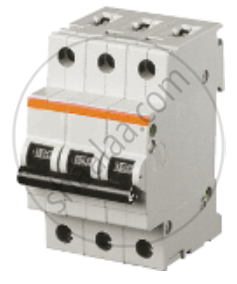
Identify the figure and give its use.
Statement 1 : Electric current ( flow of electrons ) creates heat in the resistor.
Statement 2 : Heat in the resistor is created according to the rule of energy conservation.
Explain Statement 1 with the help of Statement 2.
Why does tungsten metal used to make solenoid type coil in an electric bulb?
Answer the following question:
what is the heating effect of the electric current? state any four applications of it?
These days when current in the circuit suddenly increases _______ switches are used.
Which of the following substance contracts on heating?
Find the odd one out and give its explanation.
Write scientific reason.
A coil made up of alloy Nichrome is used in the electric heater cooker as a resistor.
Explain the importance/uses of fuse wire.
Define fuse.
An electric iron consumes energy at the rate of 420 W when heating is at the maximum rate and 180 W when heating is at the minimum rate. The applied voltage is 220 V. What is the current in each case?
An electric iron draws a current of 4 A when connected to 220 V mains. Its resistance must be:
Assertion: Bending of wire decreases the resistance of the electric wire.
Reason: The resistance of a conductor depends on length, thickness, nature of material and temperature of the conductor.
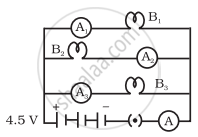
B1, B2 and B3 are three identical bulbs connected as shown in Figure. When all the three bulbs glow, a current of 3A is recorded by the ammeter A.
- What happens to the glow of the other two bulbs when the bulb B1 gets fused?
- What happens to the reading of A1, A2, A3 and A when the bulb B2 gets fused?
- How much power is dissipated in the circuit when all the three bulbs glow together?
Three incandescent bulbs of 100 W each are connected in series in an electric circuit. In another circuit another set of three bulbs of the same wattage are connected in parallel to the same source.
- Will the bulb in the two circuits glow with the same brightness? Justify your answer.
- Now let one bulb in both the circuits get fused. Will the rest of the bulbs continue to glow in each circuit? Give reason.
An electric component used as a safety device is electric circuit is ______.
Can we use the same fuse in a geyser and a television set? Explain.
An MCB can be used instead of a fuse in an electrical circuit.
Copper wire offers very little ______ and does not get heated up quickly.
A student boils water in an electric kettle for 20 minutes. Using the same mains supply he wants to reduce the boiling time of water. To do so should he increase or decrease the length of the heating element? Justify your answer.
What is a trip switch?
A fuse is used in an electric circuit to stop high currents flowing through the circuit.
The electric fuse works on the Joule heating principle.
If 220 V potential difference is applied across an electric bulb, a current of 0.45 A flows in the bulb. What must be the power of the bulb?
An electric kettle consumes 1 kW of electric power when operated at 220 V. A fuse wire of what rating must be used for it?
