Advertisements
Advertisements
Question
Give scientific reasons for the following:
Newton's gravitational law is the universal law of gravitation.
Advertisements
Solution
Newton's gravitational law is applicable throughout the universe and to all particles. Hence, it is called the universal law of gravitation.
APPEARS IN
RELATED QUESTIONS
What is the importance of the universal law of gravitation?
How will you ‘weigh the sun’, that is estimate its mass? The mean orbital radius of the earth around the sun is 1.5 × 10⁸ km.
State two applications of universal law of gravitation.
A semicircular wire has a length L and mass M. A particle of mass m is placed at the centre of the circle. Find the gravitational attraction on the particle due to the wire.
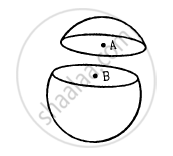
A thin spherical shell having uniform density is cut in two parts by a plane and kept separated as shown in the following figure. The point A is the centre of the plane section of the first part and B is the centre of the plane section of the second part. Show that the gravitational field at A due to the first part is equal in magnitude to the gravitational field at B due to the second part.
A ball is thrown vertically upwards. It goes to a height 20 m and then returns to the ground. Taking acceleration due to gravity g to be 10 ms-2 , find :
the total time of journey of the ball .
Is the law of gravitation applicable in case of the sun and the moon?
Where will you weigh more: at the moon's surface or at the earth's surface?
What does a force do in the following case?
You twist a piece of rubber.
Name and state the action and reaction in the following case:
A book lying on a table.
Name and state the action and reaction in the following case:
Hammering a nail.
Two equal and opposite forces acting at the same point on a stationary body. Will the body move? Give reason to explain your answer.
What is the difference between gravity and gravitation?
Explain the difference between g and G.
Does the force of the earth's gravitation affect the motion of the moon? Explain your answer with reasons.
Solve the following problem.
Find the gravitational force between the Sun and the Earth.
Given Mass of the Sun = 1.99 × 1030 kg
Mass of the Earth = 5.98 × 1024 kg
The average distance between the Earth and the Sun = 1.5 × 10¹¹ m.
The value of universal gravitational constant (G) in the SI unit is ______.
As observed from earth, the sun appears to move in an approximate circular orbit. For the motion of another planet like mercury as observed from earth, this would ______.
We can shield a charge from electric fields by putting it inside a hollow conductor. Can we shield a body from the gravitational influence of nearby matter by putting it inside a hollow sphere or by some other means?
Shown are several curves (Figure). Explain with reason, which ones amongst them can be possible trajectories traced by a projectile (neglect air friction).
