Advertisements
Advertisements
Question
State Kepler’s law which is represented by the relation r3 ∝ T2.
Advertisements
Solution
Kepler’s law of periods states that: The cube of the mean distance of a planet from the sun is directly proportional to the square of the time it takes to move around the sun.
APPEARS IN
RELATED QUESTIONS
What happens to the force between two objects, if the distance between the objects is doubled and tripled?
Can you think of two particles which do not exert gravitational force on each other?
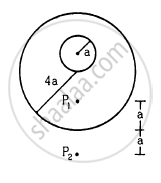
A uniform metal sphere of radius a and mass M is surrounded by a thin uniform spherical shell of equal mass and radius 4a (In the following figure). The centre of the shell falls on the surface of the inner sphere. Find the gravitational field at the points P1 and P2 shown in the figure.
The mass of moon is about 0.012 times that of earth and its diameter is about 0.25 times that of earth. The value of G on the moon will be:
Name and state the action and reaction in the following case:
A book lying on a table.
As observed from earth, the sun appears to move in an approximate circular orbit. For the motion of another planet like mercury as observed from earth, this would ______.
Answer the following questions in reference to the figure below:

- Which relation is shown in the figure?
- What will happen if the mass of one of the objects is doubled?
The Superposition Principle states that the net gravitational force on an object is ______.
Who measured the value of the Universal Gravitational Constant G using the Cavendish balance?
A hollow spherical shell of uniform density exerts what gravitational force on a point mass placed inside it?
